Tuesday, January 29, 2019
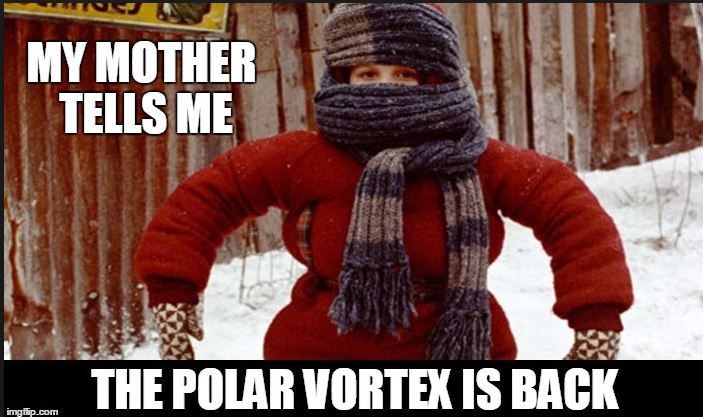
Winter arrives with a vengeance
We've had a mild winter here in Wisconsin so far, and it feels a bit like we're making up for it this week. If you live here in the frozen North, chances are, you already know how to deal with the cold. But here are some helpful tips from the CDC in case you need a little refresher.

Tuesday, January 22, 2019
Marie Kondo and books
It seems like everyone knows who Marie Kondo is. This "queen of organization" has best-selling books and a new series on Netflix.
But her approach to books? I can't quite get behind that. Annie found this meme that easily describes our feelings about keeping less than 30 books. It appears that other librarians did not agree either.


World Health Organization publishes list of ten threats to global health

This month, WHO published a list of the ten health challenges it deemed most dangerous to global population health.
Monday, January 21, 2019
In honor of Martin Luther King Jr. Day
Most of us are familiar with Martin Luther King, Jr.'s "I Have a Dream" speech. But in reading more about him, I discovered some of his philosophy that I was less familiar with. As it directly relates to the work that libraries do, I wanted to share it with all of you:
SIX STEPS OF NONVIOLENT SOCIAL CHANGE
The Six Steps for Nonviolent Social Change are based on Dr. King’s nonviolent campaigns and teachings that emphasize love in action. Dr. King’s philosophy of nonviolence, as reviewed in the Six Principles of Nonviolence, guide these steps for social and interpersonal change.
- INFORMATION GATHERING:To understand and articulate an issue, problem or injustice facing a person, community, or institution you must do research. You must investigate and gather all vital information from all sides of the argument or issue so as to increase your understanding of the problem. You must become an expert on your opponent’s position.
- EDUCATION:It is essential to inform others, including your opposition, about your issue. This minimizes misunderstandings and gains you support and sympathy.
- PERSONAL COMMITMENT:Daily check and affirm your faith in the philosophy and methods of nonviolence. Eliminate hidden motives and prepare yourself to accept suffering, if necessary, in your work for justice.
- DISCUSSION/NEGOTIATION:Using grace, humor and intelligence, confront the other party with a list of injustices and a plan for addressing and resolving these injustices. Look for what is positive in every action and statement the opposition makes. Do not seek to humiliate the opponent but to call forth the good in the opponent.
- DIRECT ACTION: These are actions taken when the opponent is unwilling to enter into, or remain in, discussion/negotiation. These actions impose a “creative tension” into the conflict, supplying moral pressure on your opponent to work with you in resolving the injustice.
- RECONCILIATION:Nonviolence seeks friendship and understanding with the opponent. Nonviolence does not seek to defeat the opponent. Nonviolence is directed against evil systems, forces, oppressive policies, unjust acts, but not against persons. Through reasoned compromise, both sides resolve the injustice with a plan of action. Each act of reconciliation is one step close to the ‘Beloved Community.’
2019 MLA Webinar Survey
As you may have seen, MLA has released
the dates and descriptions of all of their planned webinars for 2019. As WHSLA Professional Development
Coordinators, we are reaching out to all of you to help gather some information
as we decide which webinars should receive priority for GMR funding
applications on behalf of WHSLA.
Our goal is to apply for funding to
host the webinars with the highest amount of interest first. Since we can only apply for GMR funding once
per quarter as WHSLA, our secondary goal with the survey information is to help
facilitate code sharing with other organizations that may receive funding and
have extra codes available.
How to help:
- Go to MLA
2019 webinars to read a description of each webinar.
- Take
the 2019
MLA Webinar interest survey by January 31, 2019. The survey should take about two minutes
to complete.
Thank you for helping us plan our 2019
Professional Development!
Sincerely,
Dora Davis and Liz Suelzer
Thursday, January 17, 2019
Harmless meme or data mining?
If you use any kind of social media, by now you've probably seen the "how hard did aging hit you" meme floating around. People post a photo of themselves back in 2009 (or earlier) next to a current photo.
Last semester, I took an information security class, and since then, I've been more acutely aware of what information I post online. This article from Wired raised some interesting points.
Last semester, I took an information security class, and since then, I've been more acutely aware of what information I post online. This article from Wired raised some interesting points.
 |
| Conan O'Brien says the years have not been kind to him. |
Wednesday, January 16, 2019
Organ transplants from a surgeon's perspective
I recently came across this interview with Wisconsin transplant surgeon Joshua D. Mezrich. He gives some insight into the organ donation process and discusses his new memoir, When Death Becomes Life.
If you're in the Madison area, Dr. Mezrich will be at the Middleton Public Library on January 31st to discuss the book and sign copies.
I haven't had a chance to read it myself yet, but it's getting some rave reviews.

If you're in the Madison area, Dr. Mezrich will be at the Middleton Public Library on January 31st to discuss the book and sign copies.
I haven't had a chance to read it myself yet, but it's getting some rave reviews.
Tuesday, January 8, 2019
Moose on the loose
A moose walks into a hospital lobby...
No, this isn't one of the terrible jokes I'm so fond of. This actually happened yesterday in Alaska Regional Hospital in Anchorage. No one was hurt. The moose sauntered in through a door that was stuck open, grazed on the lobby plants, then headed back out. I've seen some odd things working in a hospital, but nothing quite like that.

No, this isn't one of the terrible jokes I'm so fond of. This actually happened yesterday in Alaska Regional Hospital in Anchorage. No one was hurt. The moose sauntered in through a door that was stuck open, grazed on the lobby plants, then headed back out. I've seen some odd things working in a hospital, but nothing quite like that.

Wednesday, January 2, 2019
Realistic resolutions
As the new year approaches, many people feel compelled to make resolutions to lead better, healthier lives over the next twelve months.
After overindulging on too many delicious buttery, sugary treats over the holidays, many of us resolve to "eat right." But what does that even mean? This article by Mark Bittman and Dr. David Katz sheds some light on the topic. It's a lengthy but interesting read.
Here's what I got out of it: Avoid fad diets. Eat more plants. Moderation is generally good. Nutritional advice seems so contradictory because every human body is a little different and this makes diet research complicated. Small doses of bacon/booze probably won't kill you, but don't ingest them believing they're "healthy." Again, moderation.
If the BMJ taught us anything last week, it's that you can't always rely on abstracts/summaries alone. So don't just take my word for it; give that one a read.
Interested in self-improvement, but not into self-help books? I highly recommend Mark Manson's The Subtle Art of Not Giving a F***. It's sort of like Don't Sweat the Small Stuff, but funnier and with more profanity. Manson doesn't suggest that we stop caring about anything, but that we have a limited number of effs to give, and we'll all be happier if we'd allocate them more selectively. From the back cover: Manson makes the argument—backed by both academic research and well-timed poop jokes—that improving our lives hinges not on our ability to turn lemons into lemonade, but on learning to better stomach lemons. Human beings are flawed and limited—as he writes, “Not everybody can be extraordinary—there are winners and losers in society, and some of it is not fair or your fault.” Manson advises us to get to know our limitations and accept them. This, he says, is the real source of empowerment. Once we embrace our fears, faults, and uncertainties—once we stop running from and avoiding, and start confronting painful truths—we can begin to find the courage and confidence we desperately seek.

After overindulging on too many delicious buttery, sugary treats over the holidays, many of us resolve to "eat right." But what does that even mean? This article by Mark Bittman and Dr. David Katz sheds some light on the topic. It's a lengthy but interesting read.
Here's what I got out of it: Avoid fad diets. Eat more plants. Moderation is generally good. Nutritional advice seems so contradictory because every human body is a little different and this makes diet research complicated. Small doses of bacon/booze probably won't kill you, but don't ingest them believing they're "healthy." Again, moderation.
If the BMJ taught us anything last week, it's that you can't always rely on abstracts/summaries alone. So don't just take my word for it; give that one a read.
Interested in self-improvement, but not into self-help books? I highly recommend Mark Manson's The Subtle Art of Not Giving a F***. It's sort of like Don't Sweat the Small Stuff, but funnier and with more profanity. Manson doesn't suggest that we stop caring about anything, but that we have a limited number of effs to give, and we'll all be happier if we'd allocate them more selectively. From the back cover: Manson makes the argument—backed by both academic research and well-timed poop jokes—that improving our lives hinges not on our ability to turn lemons into lemonade, but on learning to better stomach lemons. Human beings are flawed and limited—as he writes, “Not everybody can be extraordinary—there are winners and losers in society, and some of it is not fair or your fault.” Manson advises us to get to know our limitations and accept them. This, he says, is the real source of empowerment. Once we embrace our fears, faults, and uncertainties—once we stop running from and avoiding, and start confronting painful truths—we can begin to find the courage and confidence we desperately seek.

Geeking out on copyright: Many 1923 works are now free
January 1, 2019 is a good day for fans of the public domain. Why? "For the first time in over 20 years, published works (music, art, literature) will enter the U.S. public domain" (Center for the Study of the Public Domain, 2018). What does that mean? Well, there will be a lot more versions of 1923 "classics", including works by Agatha Christie, Edgar Rice Burroughs (Tarzan), e.e. cummings, Robert Frost, and many more.
Want to learn more? Take your pick of the articles online...there are a lot more people excited about this than you think.
Center for the Study of the Public Domain. (2018). Public Domain Day 2019. Retrieved from https://law.duke.edu/cspd/publicdomainday/2019/.
Want to learn more? Take your pick of the articles online...there are a lot more people excited about this than you think.
 |
| One of the worst films of 1923? |
 |
| The Prophet comes into the public domain on 1/1/2019 |
Center for the Study of the Public Domain. (2018). Public Domain Day 2019. Retrieved from https://law.duke.edu/cspd/publicdomainday/2019/.
Subscribe to:
Posts (Atom)