Thursday, June 2, 2022

Radio Advisory: The Evolving World of Clinical Evidence


About this Episode

The life sciences part of health care isn't just drugmakers and medical device companies—data and evidence coming from life sciences is critical to the entire health care ecosystem. In this episode, Rachel Woods sits down with Advisory Board's Solomon Banjo and Pam Divack, and SVP of Optum Life Sciences Lou Brooks, to talk about the evolving role of evidence and how evidence impacts all parts of the health care ecosystem.


MM's comment: No mention of Libraries role in evolving clinical evidence, but I thought it was something most of us would want to stay on top of ...

Wednesday, June 1, 2022

June Programming (no cost) via the Science and Technology Section (STS) of ACRL (Association of College and Research Libraries)

 The Science and Technology Section (STS) of the Association of College and Research Libraries (ACRL) invites you to join us for as many of our FREE virtual programs in June 2022 as you would like.  Information for each of our five (5) sessions is below, along with registration links, where applicable.  We hope to see you there!  


June 7, 2022, 3:00-4:30pm ET -  STS Hot Topics Summer Discussion

  The COVID-19 pandemic has seen a rapid proliferation of scientific output, with the release of many pre-prints, datasets, and scholarly articles, as well as the popular articles that discuss them. With the output of articles retractions and misinformation also followed. The STS Hot Topics committee will host a discussion session to examine changes to scientific publishing and communication practices during the pandemic. 

  The discussion session will feature brief talks and multiple breakout sections for participants to discuss impacts to our own work. Our speakers will be:

·  Ms. Julia Gelfand, Applied Sciences & Engineering Librarian at the University of California Irvine. She will be speaking on "STEM Publishing Lessons Learned from the Pandemic: New Practices for Libraries & Publishers". 

·  Dr. Jodi Schneider, Assistant Professor of Information Sciences at the University of Illinois Urbana-Champaign. She will be speaking on retractions in publications during the pandemic.

  Please join us via Zoom on June 7th from 3:00 - 4:30 pm ET. Register in advance for this meeting: https://go.umd.edu/hottopicssummer22. Speaker presentations will be recorded. Breakout room and general discussions will not be recorded. 

  After registering, you will receive a confirmation email containing information about joining the meeting. If you have any questions regarding this event, please email ACRL STS Hot Topics Committee Co-Chairs, Isabella Baxter (ibaxter@umd.edu) and Mike Goates (michael_goates@byu.edu). 


June 13, 2022, 2:00pm-3:00pm ET - 2022 STS Government Information Update

  Join us for the annual STS Government Information Update! This year's topic is the new National Institutes of Health (NIH) Data Management and Sharing Policy that will be implemented in January 2023. The potential impacts of this policy on libraries and library workers will be addressed by our four presenters: Kristin Briney (Biology & Biological Engineering Librarian at Caltech), Lisa Federer (Data Science and Open Science Librarian at the National Library of Medicine), Taunton Paine (Director of Scientific Data Sharing Policy at NIH), and Robyn Reed (Biomedical Informatics and Emerging Technologies Librarian at Penn State College of Medicine).

  This is a free, virtual program that is open to all. Register in advance at https://bit.ly/3scysvr 

  After registering, you will receive a confirmation email containing information about joining the meeting.


June 14, 2022, 1:00pm-4:00pm ET - 2022 STS Annual Program

  This free program will be held virtually and will consist of three (3) parts: 

·  (A) 1:00pm-2:30pm - The (Pending) Science Information Literacy Framework:  Three panelists will introduce the new (pending) Science Information Literacy Framework (https://acrl.libguides.com/sts/STSILFramework): Nikki Rech (Sciences Research and Instruction Librarian at Georgia Southern University, and member of the Task Force that wrote the framework); Aditi Gupta (Engineering & Science Librarian at University of Victoria Libraries); and Anamika Megwalu (Faculty Director of Library Instruction & Assessment at San Jose State University). Then participants will break into small groups to discuss their experiences with and/or to delve deeper into the framework.  Sponsored by the 2022 STS Conference Program Planning Committee. 

·  (B) 2:30pm-3:00pm - Networking time

·  (C) 3:00pm-4:00pm - Equitable Practices in Scholarly Communications:  Join Yasmeen Shorish, Head of Scholarly Communications Strategies & Special Advisor to the Dean for Equity Initiatives at James Madison University, for a talk and discussion of equitable practices in scholarly communications.  Sponsored by the STS Professional Development Committee.

  You are welcome to attend any or all parts. Register at https://go.umd.edu/STS2022

  Many thanks to Elsevier for sponsoring the live captioning for this program!


June 15, 2022, 3:00pm-5:00pm ET - 2022 STS Research Forum & Membership "Breakfast"

  This free program combines the STS Research Committee's Research Forum presentations with the STS Membership "Breakfast." The Research Forum from 3-4 ET and the Membership "Breakfast" from 4-5 ET. Come for part or all!

  In the first hour of the program, the STS Research Forum will consist of two presentations, with time for questions and answers at the end. The two presentations will be:

·  The Status of Women in STEM in Higher Education in the United States during the COVID-19 Pandemic: A Review for STEM Librarians - Heidi Blackburn, George Mason University

·  Understanding Open Access (OA) Trends in Engineering through Scholarly Assessment: A Bibliometric Analysis of Open Access Publications at the College of Engineering at the University of Arkansas-Fayetteville - Jonathan M. Torres, Rutgers University-Newark , and Jay McAllister, University of Arkansas Libraries

  The second hour of the program will be a virtual membership "breakfast" with casual discussions in breakout rooms. Learn how your science librarian colleagues are handling issues such as transformative publishing agreements and the great reshuffle/resignation or choose to talk about new things you're learning and excited to share. This is a wonderful time to reconnect with colleagues from around the country! 

  Register in advance for this event:

https://uic.zoom.us/meeting/register/tZAoc-ihrD4sHdLziEbDphEaRpeyxXlRDH0g  


June 16, 2022, 3:00pm-4:00pm ET - 2022 STS Lightning Talks

  The STS Research Committee will host its free virtual Lightning Talks session on Thursday, June 16. The session will consist of three short presentations, with time for questions and answers at the end. The three sessions will be:

·  Using curriculum mapping to improve information literacy instruction in engineering - Tracy Zahradnik, University of Toronto

·  Incorporating the ACRL Information Literacy Framework into a Natural Resources Management Decision-making Framework - Patricia Hartman and Robert Gitzen, Auburn University

·  Beyond ENIAC, LO, and Reaper: Promoting DEIA in the History of Computing - Carmen Cole, Penn State University

  Register at https://forms.gle/tHUTFGPhZVRbWkmr7


Please contact Bonnie L. Fong (STS Vice-Chair/Chair-Elect) at LibrarianBonnieFong@gmail.com if you have any questions.
Dance Plagues and Red Shoes

The Red Shoes by Kate Bush (1990s throwback)

Last month, I read an article by BBC News about a real life dance plague (aka choreomania) that inspired Hans Christian Anderson's classic The Red Shoes.

Here's a quote to whet your appetite or just help explain why it's relevant for today:

Ecstasy and anger

It was perhaps inevitable that the dancing plague regained popularity now. The last two years have yielded feverish interest in the many pandemics that have gone before us, from the Black Death to the Spanish Flu. We have looked to them not only for comparison, but also, seemingly, to reassure ourselves that all epidemics eventually end. Within that, something tenuously classed as a plague where the contagion isn't sickness, but movement was always going to be alluring. As Welch acknowledges, one of the things lost during lockdown was the communality of dancing: that exquisite feeling of being physically proximate to hundreds of other people, everyone carried by music that commands the muscles and turns a sea of strangers into fellow travellers bound by shared experience.


A Time to Dance, a Time to Die: The Extraordinary Story of the Dancing Plague of 1518 by John Waller

In case you were wondering, a quick and dirty search of PubMed brought up a handful of articles on "choreomania OR dancing plague."


There are many interpretations of The Red Shoes out there.  Just Google it, and you'll see!  To me The Red Shoes was less about moralizing and punishment for the vanity of wanting a pair of pretty dance shoes, and more about getting swept up in something you can't control -- like addiction, or possession, or even just loosing your footing in a meaningful life.  If you don't have plans for your own life, someone else will and it may not be to your liking.   


If you are fascinated with this tangent of story as medicine, check out Clarisa Pinkola Estes' classic book, Women who Run with the Wolves.  The author is a Jungian analyst and cantadora [Keeper of the Stories] and includes a long chapter on The Red Shoes and a compelling interpretation.    It is one of my all-time favorite books ever. ;-)


Wednesday, May 25, 2022

Webinar: Advocacy & Strategic Planning for the Health Care Library


Michele Matucheski: I caught the following webinar this week, and wanted to share it with anyone interested.  The speakers go over some highlights from the forthcoming newly revised Hospital Librarian Standards from the Medical Library Association (MLA) and the newly revised Advocacy Tool Kit, neither of which has been published / released just yet.  Something to look forward to!

Webinar: Advocacy and Strategic Planning for the Healthcare Library

from May 24, 2022


Librarians play a crucial role in healthcare organizations. Your work impacts the entire hospital community, bridging the gap between information, data and practice. Amongst other services, you support your clinicians with evidence-based research so that patients receive the best possible care. Ensuring that the wider healthcare community is aware of your value is critical to receiving ongoing resources and support for your medical library.

In this webinar, join leading librarian speakers from the healthcare community as they share advocacy initiatives at their own libraries and outline how they're evolving in response to current issues to better support their users.

Watch Recording
Featuring speakers from Memorial Sloan Kettering Cancer Center and Valley Children's Healthcare, we'll cover important topics such as:
Strategic planning post covid
The impact of the library on patient care
The importance of virtual and physical library support
How to advocate for your healthcare library

Speakers

Delf Bintakies

Donna Gibson, MLS

Director of Library Services, Memorial Sloan Kettering Cancer Center

Donna Gibson is the Director, Library Services for Memorial Sloan Kettering (MSK) Cancer Center and has been in this role since August 2009. She joined MSK in 2004 as Associate Director, User Services. Prior to this, she worked at Bristol-Myers Squibb in various roles, managing research libraries and information centers.

Delf Bintakies

Brian L. Baker, MLS, JD

Library Services Program Manager & Literacy Program Coordinator, Valley Children's Healthcare

Brian Baker started his library career as Director of the Fairfax Public Law Library in 1989. Following this, Brian had a 22-year career as a Law Librarian, including 9+ years as Director of the Law Library at the University of the District of Columbia David A. Clarke School of Law. Brian also worked as a Prison Librarian for 18 months. He has now been working as a Hospital Librarian for over seven years.

Thursday, May 19, 2022

Information Literacy Basics

 Well, if you read today's email notifying you there were new WHSLA blog posts, you know that I'm FINALLY about to graduate with my MLIS!!!  I meant to share this sooner, but I've still been sort of frazzled this week after wrapping up all my final projects.  This was one of them!  I had a lot of fun making this live action video for my Information Technologies class.  My goal was to show that you don't have to have specialized equipment to create an educational video.  I filmed this on my cell phone and edited it with an app called InShot.


Wednesday, May 18, 2022

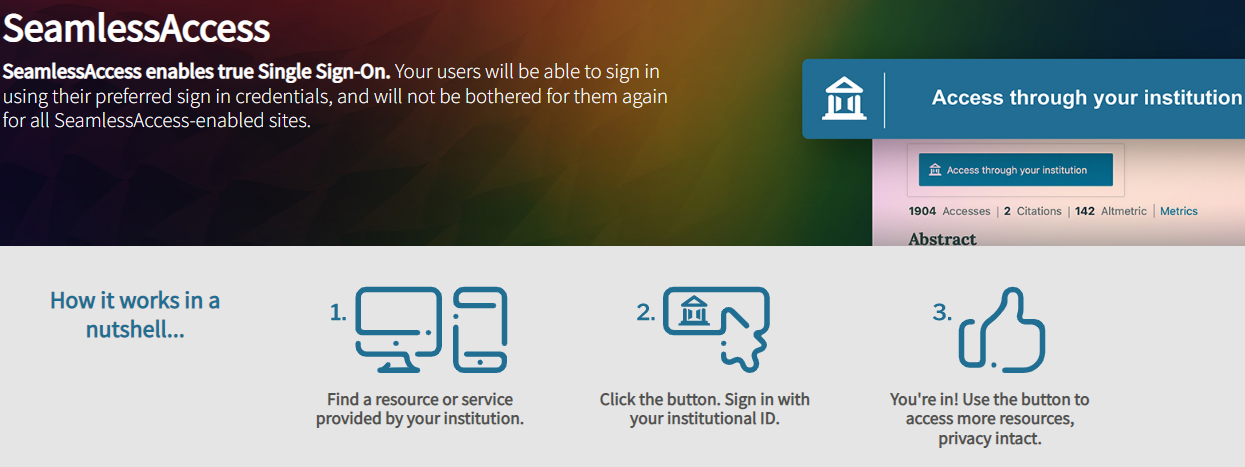
Have You Heard of Seamless Access?


One of the most useful sessions I saw at the virtual MLA 22 Conference this month was a paper about SeamlessAccess.org:  

We're all in this together: So SeamlessAccess is a Thing, and the Browser is Changing, What Do I need to Do or Know?   by Linda van Keuren and Michelle Volesko Brewer.

Disruptions in access (ie, not being able to get to a fulltext article we've paid for, or being locked out of a subscription database) happen for a variety of reasons.  We've all seen these or similar access troubles in our own libraries.   It is one of the banes of Librarianship in this virtual age.

SeamlessAccess.org keeps tabs on the changing landscape of authentication as IPs become one of the more rare and problematic forms of authentication.  SeamlessAccess grew out of RA21 that first appeared in 2016, concluding that "federated authentication held the most promise for providing a robust, scalable solution for remote access to scholarly content."   

This is something I need to stay on top of (and I imagine many of you do, too!) as our IT makes changes where IP authentication will be harder and harder to maintain as the primary means to access our licensed library resources.   RA21 and SeamlessAccess make more sense to me than setting up proxy servers and making people keep track of yet another username and password.  We're already using it to sign into some products and services when they tap into ActiveDirectory, so it should be somewhat familiar to our IT Depts.


How it works:

  1. Find a resource or service provided by your institution.
  2. Click the "Access through your institution" button.  Sign in with your institutional ID.
  3. You're in! Use the button to access more resources, privacy intact.

The speakers also brought up a new wrinkle that I had not previously considered would be an issue for us: The fact that internet browsers (Chrome, Safari, Firefox, Edge and others) will soon be making updates to improve privacy and security where they clamp down on the rampant use of cookies.  Unfortunately, they won't be able to distinguish between good cookies that help foster seamless access to library resources and the more nefarious cookies that want to track users for targeted advertising purposes.   

If you want to know more, check out the links below:

The Learning Center at Seamless Access.org includes the following resources:

    Watch videos on:
  • Access Apocalypse: Be Prepared for Anything
  • How Federated Authentication Works
  • Privacy, Attributes, and Why They're Important
  • The Problem with IP Authentication

Did I mention it's FREE?  

I suspect products and services like LibLynx and Nomad use seamless access vs setting up expensive proxy servers, while OpenAthens and EZProxy use the same technology for authentication.   Those services can provide value-added user stats and remote access, which are not free.

What has been your experience with providing seamless access (Single Singon) for your library users and researchers?  Have you found a solution that works?  

Tuesday, May 17, 2022

Are You Missing the Nursing Journals Subset in PubMed? Here's the workaround ...


Last fall, PubMed eliminated the beloved Nursing Journals subset / filter, among others.  Read the announcement from the NLM Technical Bulletin.

For those of us who frequently search the nursing literature, this was a handy filter that is sorely missed in PubMed.  NLM did offer a workaround, by recommending that individuals save the following search strategy in MyNCBI and pull it up when needed.

Let us know if you've found something that works better ...  

Note: I tried to set this up as a custom filter in MyNCBI (hoping it would show up with my other frequently used filters) and be a 1-click solution, but the strategy is too long to work that way and is therefore ignored.  Better as a saved search strategy.


Monday, May 16, 2022

Emotions & Disease


The National Library of Medicine (NLM) recently redesigned the online presentation of its exhibition titled "Emotions & Disease." Held in the Library’s building in Bethesda, MD, 25 years ago, the exhibition explored the intersection of the mind & body. 

Circulating Now (from the Historical Collections of NLM) interviewed Esther Sternberg, MD, exhibition director, and Ted Brown, PhD, guest curator, about their work on the original exhibition and the continued relevancy of its message today.   Read more ...


Explore the online presentation of its exhibition Emotions and Disease and view the catalog of the original physical exhibition in NLM Digital Collections.

Sunday, May 15, 2022

Hospital Postcards from The American Hospital Association

The former Kuks Hospital in the Czech Republic. Undated postcard.


Circulating Now (from the historical collections of The National Library of Medicine) recently featured an article by Ginny Roth about hospital postcards.  I know I have several older postcards from Mercy Medical Center in Oshkosh and St Elizabeth Hospital in Appleton in our local archival collections.  I wonder if they are part of this new collection?

This National Postcard Week, celebrated May 1-7 2022, the National Library of Medicine (NLM) is pleased to announce its recent acquisition of a second collection of hospital postcards. Donated by the American Hospital Association (AHA), the collection builds on a previous acquisition donated by W. Bruce Fye and adds to the wealth of the Library’s visual material documenting the history of hospitals.

This collection consists of over 2,500 postcards and provides a visual record of primarily U.S. hospitals, sanitoriums, and other related buildings. In addition to the United States, 3 other countries are represented, Canada, the Czech Republic, and England. Prior to coming to NLM, the collection was part of the Center for Hospital and Healthcare Administration History, sponsored jointly by the AHA and American College of Healthcare Executives.    Read more ...

Saturday, May 14, 2022

NIH Data Management and Sharing Requirements - Roundup of Training Resources


One of NLM's prominent messages this year at MLA-22 was about preparing for the Data Management & Sharing Plan Requirements that go into effect January 2023.

NLM / NIH are seeking to strike a balance between data access vs. data protection / privacy.  We know there will be more innovation when the data is shared widely, but it needs to be balanced with keeping personal data secure. 

Patti Brennan gave the example of the current waste water studies tracking community rates of Covid-19.  Those samples contain personal DNA along with viral DNA of Covid/SARS-Cov-2.  How do we separate and secure the personal DNA data from the viral DNA data and make that available and useable by other researchers?  

Librarians in attendance asked NIH to provide templates or prototypes as examples of data management set plans.  They said they would provide guidelines, but not templates, because every data management plan will be different according to the data produced.

Key Points:
  • You don't have to be a statistician to [help a researcher] write a data plan.  
  • It's more thinking about how the data will be managed and shared.  
  • A DMSP is designed to be 2 pages or less. [Now--Doesn't that make it seem do-able?]
I am not a Data Librarian, and I'm still wrapping my head around how I can apply this in my health care setting, but wanted to set it down here for those who want to  ...

Learn More:

Data Clearinghouse https://sharing.nih.gov
    
    > The Data Clearninghouse is where you'll find the "meat and potatoes" of what will be required in January 2023, including more info on the following:
    
Data Management & Sharing Policy (DMSP)
    • About
    • Overview
    • Research Covered Under DMSP
    • Planning & Budgeting for DM&S
    • Data Management
      • FAIR Principles
      • Length of Time to Maintain Data
      • Metadata and Other Associated Documentation
      • Naming Conventions
      • Common Data Elements
      • Data Storage Format
      • Data Security
    • Sharing Scientific Data
      • Data Sharing Approaches
      • Selecting a Data Repository
      • Repositories for Sharing Scientific Data