Showing posts with label intellectual freedom. Show all posts

Tuesday, April 22, 2025

The ALA Library Bill of Rights

It's been a long time since I was in Library School and had that very important, stimulating and thought-provoking Intellectual Freedom class with Diane Hopkins at SLIS.   I've only been confronted with censorship in my health science library 2x in the last 25 years.   It does come up, but less often than in public or school libraries.   Still, intellectual freedom (and DEI) remains an important foundation in my professional practice.  It may be time to make this part of our official policies.  

With the current political environment and rampant book bans in schools, public and now even military libraries, I thought it would be a good idea to review the American Library Association's Bill of Rights:


The ALA Library Bill of Rights

The American Library Association affirms that all libraries are forums for information and ideas, and that the following basic policies should guide their services.

I. Books and other library resources should be provided for the interest, information, and enlightenment of all people of the community the library serves. Materials should not be excluded because of the origin, background, or views of those contributing to their creation.

II. Libraries should provide materials and information presenting all points of view on current and historical issues. Materials should not be proscribed or removed because of partisan or doctrinal disapproval.

III. Libraries should challenge censorship in the fulfillment of their responsibility to provide information and enlightenment.

IV. Libraries should cooperate with all persons and groups concerned with resisting abridgment of free expression and free access to ideas.

V. A person’s right to use a library should not be denied or abridged because of origin, age, background, or views.

VI. Libraries which make exhibit spaces and meeting rooms available to the public they serve should make such facilities available on an equitable basis, regardless of the beliefs or affiliations of individuals or groups requesting their use.

VII. All people, regardless of origin, age, background, or views, possess a right to privacy and confidentiality in their library use. Libraries should advocate for, educate about, and protect people’s privacy, safeguarding all library use data, including personally identifiable information.

Adopted June 19, 1939, by the ALA Council; amended October 14, 1944; June 18, 1948; February 2, 1961; June 27, 1967; January 23, 1980; January 29, 2019.

Inclusion of “age” reaffirmed January 23, 1996.

Although the Articles of the Library Bill of Rights are unambiguous statements of basic principles that should govern the service of all libraries, questions do arise concerning application of these principles to specific library practices. See the documents designated by the Intellectual Freedom Committee as Interpretations of the Library Bill of Rights.


Wednesday, August 9, 2023

MLA's Censorship & Library Practices Tool Kit


Guest Post by Margaret Ansell, AHIP

The Medical Library Association (MLA) just released a Censorship & Library Practices Toolkit. 

A core value of librarianship is to provide accessible and trustworthy health information. However, institutional policies and regional and national laws often place limits on what information can be shared with library users. Navigating this conflict between our professional values and external rules can be a complex and difficult endeavor.  

The Censorship and Library Practices Toolkit provides resources that can assist health sciences librarians in establishing policies, procedures, and information resources that can help to minimize these potential conflicts and provide a solid basis for dealing with them when they arise. It includes:

    • Tools to Track Legislation & Upcoming Issues
    • Issue-Specific Resources
      • Privacy
      • Intellectual Freedom/Censorship
      • Reproductive Health
      • Sexual Health
        • Sexual Health Information for Minors
        • LGBTQ Health Information
      • Social Determinants of Health
    • State-Specific Resources
    • Designing & Enacting Library Policies
      • Recommended Policy Elements & Practices
      • Example Policies
      • Tips & Tricks for Enforcing Policies
    • Note About Currency & Contribution


This brief article first appeared on the MLA Connect Newsletter on July 28, 2023.
Reprinted with Ms. Ansell's permission.

Thursday, July 20, 2023

NNLM Webinar: Reproductive Health & The Reference Desk in a Post-Roe World

Reproductive Health and the Reference Desk: How libraries can provide information post-Roe

It has been over 1 year since the U.S. Supreme Court repealed Roe v. Wade. Abortion is now illegal in a significant portion of the country. What does this mean for information access? This webinar will discuss reproductive health as an information access concern, introduce the Reproductive Justice framework, and offer ideas for how libraries can provide create environments that are supportive of sexual and reproductive health information.

Guest Speaker: Barbara Alvarez is a PhD student in Information Science at University of Wisconsin–Madison with a focus on reproductive health. Barbara is the author of The Library’s Guide to Sexual and Reproductive Health Information with ALA Editions. She is a 2022 Library Journal Mover & Shaker and a 2011 Spectrum Scholar.

This presentation addresses increasing health equity through information and increasing health information access and the NNLM/NLM/NIH initiative of improving the public's access to information to enable them to make informed decisions about their health.

The Network of the National Library of Medicine is funded by the National Library of Medicine, National Institutes of Health, Department of Health and Human Services. Learn more at https://nnlm.gov


Explore Resources From MedlinePlus


Saturday, March 11, 2023

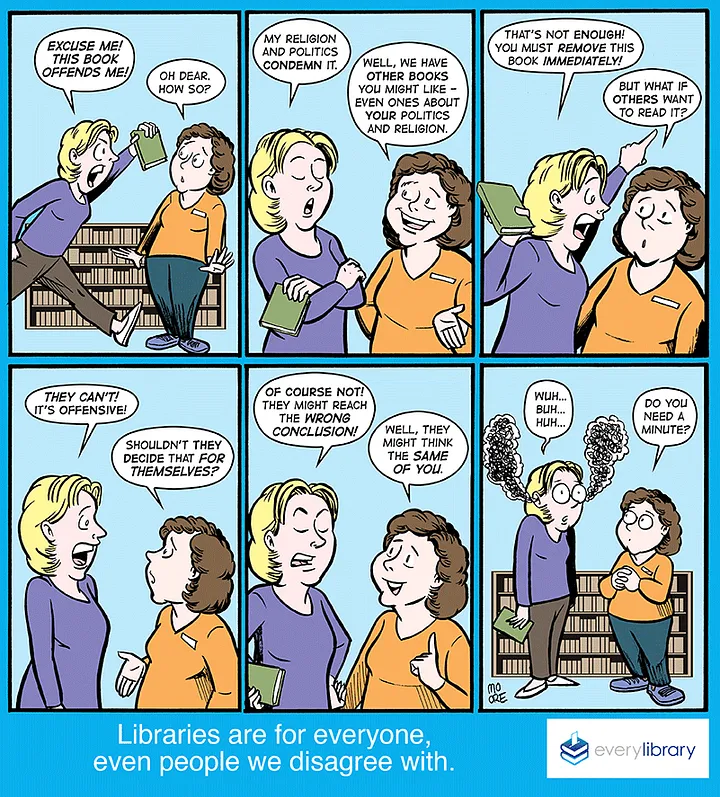
The Right Conclusion


Image from here.


“The public library isn’t anyone’s personal bookshelf. Everyone has a right to read, view, or listen to what they choose. And librarians are there to help them find it.”

                                             — Kevin Moore, 2017 EveryLibrary Artist-in-Residence


Thanks to Diane Giebink-Skoglind for sharing this comic.