A blog from WHSLA (Wisconsin Health Sciences Library Association) featuring posts on medical and health science libraries, NLM, and learning opportunities for medical and health science librarians and library staff.
It has been over 1 year since the U.S. Supreme Court repealed Roe v. Wade. Abortion is now illegal in a significant portion of the country. What does this mean for information access? This webinar will discuss reproductive health as an information access concern, introduce the Reproductive Justice framework, and offer ideas for how libraries can provide create environments that are supportive of sexual and reproductive health information.
Guest Speaker: Barbara Alvarez is a PhD student in Information Science at University of Wisconsin–Madison with a focus on reproductive health. Barbara is the author of The Library’s Guide to Sexual and Reproductive Health Information with ALA Editions. She is a 2022 Library Journal Mover & Shaker and a 2011 Spectrum Scholar.
This presentation addresses increasing health equity through information and increasing health information access and the NNLM/NLM/NIH initiative of improving the public's access to information to enable them to make informed decisions about their health.
The Network of the National Library of Medicine is funded by the National Library of Medicine, National Institutes of Health, Department of Health and Human Services. Learn more at https://nnlm.gov
Join The National Library of Medicine on Wednesday, March 15 at 3:00 p.m. ETforthe 2023 NLM Science, Technology, and Society Lecture. Renée DiResta of theStanford Internet Observatorywill discuss
"Is Misinformation the Problem? Re-examining the Infodemic."
Type of event: Science, Technology, and Society Lecture Location: NIH Videocast
Speaker(s)
Renée DiResta is the technical research manager at Stanford Internet Observatory, a cross-disciplinary program of research, teaching and policy engagement for the study of abuse in current information technologies. Renee investigates the spread of narratives across social and media networks, with an interest in understanding how platform algorithms and affordances intersect with user behavior and factional crowd dynamics. She studies how actors leverage the information ecosystem to exert influence, from domestic activists promoting health misinformation and conspiracy theories, to the full-spectrum information operations executed by state actors.
Event Description
Sponsored by the NLM Office of Strategic Initiatives, the Science, Technology, and Society Lecture aims to raise awareness around the societal and ethical implications of biomedical research conduct and the use of advanced technologies. Each spring, NLM invites a leading voice working at the intersection of biomedicine, data science, ethics, and justice to present their research and how it relates to the mission and vision of both NLM and NIH. NLM sees such considerations as fundamental to advancing biomedical discovery and human health for the benefit of all.
As COVID-19 spread across the United States, public health officials and science communicators found themselves wrangling both the pandemic and what was often described as an “infodemic,” a barrage of false and misleading information about the disease, treatments, and eventually vaccines. In this talk, we will explore that infodemic, drawing on research that examined how it took shape, what narratives reached which publics, and the network dynamics that assisted its spread. While misinformation was indeed present in many narratives that went viral, much of what proliferated is perhaps more accurately classified as rumors. Unlike misinformation, rumors are often based on incomplete or partial information - and they sometimes turn out to be true. We will examine how rumors start, why they persist and recur, and why they are so effective at spreading on social media… and, of course, some mechanisms for mitigation.
Chevy Chase, MD (AP) -- In an early morning press conference, NLM's recently appointed director Ervin D. Smarmsworth announced a new campaign to take on widespread misinformation.
"Listen, evidence-based science is great and all," said Smarmsworth, "but it's clearly not getting through to people. You know what people listen to? Anecdotes. My aunt told me her friend's brother's wife got the vaccine, and afterwards her adult onset acne totally cleared up! The vaccine may even be able to get rid of visceral -- er --- tummy fat WITHOUT diet and exercise."
When asked to cite a source for that claim, Smarmsworth made a rude noise, then replied, "Everyone knows that. Duh."
Another reporter asked if it was unethical to spread misinformation in any form. Smarmsworth rolled his eyes and replied, "Ethics? Yeah, those are about as useful as trepanning."
Warzel, C., 2021. Opinion | Don’t Go Down the Rabbit Hole: Critical thinking, as we’re taught to do it, isn’t helping in the fight against misinformation. [online] Nytimes.com. Available at: https://www.nytimes.com/2021/02/18/opinion/fake-news-media-attention.html [Accessed 22 February 2021].
This article proposes teaching students (and others) the SIFT method used by fact checkers, in part because it's quick and simple:
Stop.
Investigate the source.
Find better coverage.
Trace claims, quotes and media to the original context.
Let's continue the conversation: What do you think?
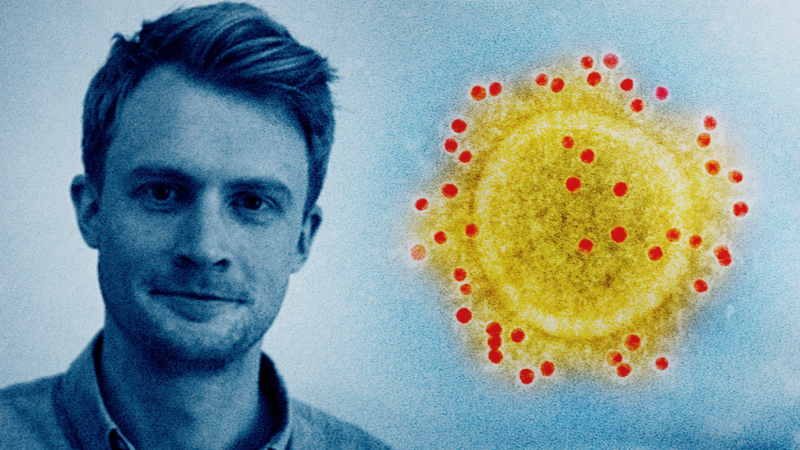
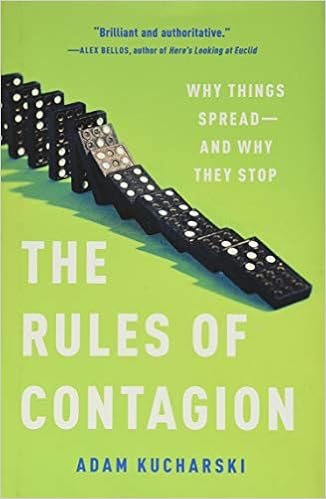
I am a regular listener of To the Best of Our Knowledge on Wisconsin Public Radio, although these days I listen to podcasts more than live broadcasts. This interview with Adam Kucharski was fascinating in that he has been able to bridge the worlds of math, epidemiology, and social contagion. We've all heard the phrase when something "goes viral" on social media. Well, it turns out the same rules from math and biology apply to the viral spread of information, or misinformation. The wheels started to whir in my brain and I had an a-ha moment where it all started to make sense! I hope you enjoy it as much as I did!
Here's Steve Paulson's introduction:
The COVID-19 pandemic was some epidemiologist’s nightmare when Adam Kucharski was writing "Rules of Contagion." The book draws on ideas from “outbreak science” to illuminate how and why viruses spread. Information from biology, Kucharski expertly demonstrates, has helped scientists understand how misinformation rages like fire in the fields of politics and finance. Kucharski is entitled to feel like Nostradamus, but people in his field “always have the next pandemic on the radar,” he told Wired.
I caught up with Kucharski to learn about the key ideas in "Rules of Contagion," and hear his views on the COVID-19 pandemic. You can read the full conversation over on Nautilus. Read more ...
Presented by Erica Brody and Hillary Miller, Librarians at Virginia Commonwealth University. This program was sponsored by he NNLM. Learn more and register to get MLA credit.
Description:In the midst of a global pandemic, every person has to balance the “need for speed” with the risks of moving too fast. Healthcare providers seek reliable information about treatments while making immediate life-or-death decisions. Researchers investigate biological mechanisms and interventions to combat COVID-19 and share their findings as quickly and responsibly as possible. And each of us wades through the flood of headlines and rumors for answers that will keep us safe. Looking at the case of hydroxychloroquine and COVID-19, we will explore the risks and rewards of different forms of information, from published articles to tweets.
Learning Objectives:
Navigate the quickly shifting landscape of information in a pandemic.
Describe ways to approach the quality of information that is being produced and disseminated at a faster pace than ever seen before
Identify the limitations and cautions of relying on a single source of information for decisions
This was one of the BEST 1-hour webinars I've seen in a long time. Erica Brody and Hillary Miller addressed many of the questions I've been wrestling with this year as a health science librarian during the ongoing Covid-19 pandemic.
Using the example of Hydroxychloroquine, Brody & Miller trace the timeline of when it first emerged as a possible treatment for Covid-19 in Jan - Feb 2020, to the point where people started demanding it from their health care providers, despite any real or conclusive evidence that it worked.
This whole evolving story of Hydroxychloroquine had me baffled as it was happening -- The research I had done clearly discounted it as a treatment for Covid, yet friends on Facebook and social media insisted that it worked, that "scientists were hiding the truth."
Brody and Miller put Preprints and Preprint servers in their rightful place in the hierarchy of evidence.
Further, they offer Tools & Tips for Navigating an Infodemic:
Scite.ai to id articles that support / refute findings. It works as a browser extension in Chrome, tracking 700+ million articles, many with big name publishers.
Tips:
Do NOT rely on a single study.
Obtain evidence from multiple sources.
Verify IF and HOW peer review was done.
Researcher's expertise should be specific to the study. Beware of celebrity doctors.
What do the authors say about the limitations of their study?
What are their conclusions?
Was this misrepresented in the media?
Finally, the speakers recommended the following article:
The recording is a little wonky in that the slides didn't kick in until half-way through, but the information is good if you treat it more like a podcast and just listen. It gives me some hope that not all is lost on this this front.
See info on the 3-part series, including links to course materials and recordings.
I don't know about you, but I've got a bad case of Infodemic Fatigue, better known as Covid Mis/Disinformation Fatigue. When will this firehose of rubbish abate? Is this how Health Science Librarians burnout?
In only 9 minutes, Dr Zubin Damania debunks the latest conspiracy theories about the new Covid vaccines. He has a long history battling anti-vaxxers. Just in case your family brings up 5G antennas at Thanksgiving dinners this year. Oh yeah--Nevermind: Thanksgiving is canceled due to the pandemic.
I posted about Newsguard back in March 2020 as a resource to fight against Covid Misinformation. They track a number of websites known for publishing misinformation on a variety of topics, not just Covid. In the report above, Dr Northrup is cited as linking to an article falsely claiming that a Covid 19 vaccine would alter your DNA.
I am really disappointed in Dr Northrup. I liked her consumer health books for women in the 2000s. Sad to see her stooping to this level. She knows better.
Newly published editorial on Infodemiology, I don't know about you, but this term brings to mind Ghost Busters suited up for battle. ;-) The issue editor gives us the larger picture in this introduction to the topic, one that he's been studying for more than 20 years as it has evolved over time. Eysenbach is poised to share his expert opinion on the nuances and challenges of this phenomenon where facts are in motion and best evidence is really just best-evidence-at-the-time (BETs). He offers the Information Wedding Cake Model above as a way to explain how the layers interact and how proper translation between levels might improve problems with misinformation. This entire issue of Journal of Internet Research focuses on Infodemiology in the wake of Covid-19 misinformation, and is worth checking out ...
From the article's abstract:
In this issue of the Journal of Medical Internet Research, the World Health Organization (WHO) is presenting a framework for managing the coronavirus disease (COVID-19) infodemic. Infodemiology is now acknowledged by public health organizations and the WHO as an important emerging scientific field and critical area of practice during a pandemic. From the perspective of being the first "infodemiolgist" who originally coined the term almost two decades ago, I am positing four pillars of infodemic management:
(1) information monitoring (infoveillance);
(2) building eHealth Literacy and science literacy capacity;
(3) encouraging knowledge refinement and quality improvement processes such as fact checking and peer-review; (4) accurate and timely knowledge translation, minimizing distorting factors such as political or commercial influences.
In the current COVID-19 pandemic, the United Nations has advocated that facts and science should be promoted and that these constitute the antidote to the current infodemic. This is in stark contrast to the realities of infodemic mismanagement and misguided upstream filtering, where social media platforms such as Twitter have advertising policies that sideline science organizations and science publishers, treating peer-reviewed science as "inappropriate content."
I just watched this useful webinar about combatting Covid-19 related misinformation from Every Library Institute and recommend it to my WHSLA Colleagues. Although the live webinar sold out, you can still register to watch the recording. If you register, you'll get access to the slides, links, and other items mentioned in the talk. The session is about 35 minutes long. If you don't have time to watch it, here are some of my notes from the session: Did you know that there's a specific term for misinformation in the age of Covid-19?
WHO refers to it as Coronavirus Infodemic in their situation reports.
Sarah Brandt was one of the presenters. She works for NewsGuard, a company that offers "nutrition labels" for news sites, where they rate credibility and transparency.
NewsGuard classifies Coronavirus Misinformation into 3 categories:
False Claims
Phony Cures
Downplaying the seriousness of Corona
NewsGuard's Step-by-Step Guide to Evaluating Claims:
[These should all look familiar to Librarians.]
What is the source?
What do other independent sources say?
Check the date. Is it current?
What's the motivation behind Coronavirus misinformation?
Common motivations for misinformation include:
-- Are they selling something?
-- Is it to get more clicks for advertising?
-- Racial - to blame the origin or spread on a particular ethnic group
-- Political
NewsGuard offers a browser extension for Chrome, Firefox, Edge, and Safari, that provides background info on website sources and their credibility. It does NOT block any sites, just provides an extra layer of evaluation.
This browser extension has been free for public libraries, but will be available to anyone until July 1, given the current environment of extreme misinformation.
More about the presenters:
Sarah Brandt is the Vice President of News Literacy Programs for Newsguard. Newsguard and their team of researchers have put together a list of websites known for publishing misinformation on COVID-19.
In his role as Director of the School Library System for the Genesee Valley Educational Partnership Christopher Harris has played a critical role in educating his students and staff on how to find credible information on the internet. In response to the COVID-19 outbreak, he compiled a valuable collection of websites where you can go to get credible and helpful information on COVID-19 and everything related.