Thursday, April 17, 2025

Reasons to Explore the Expo Floor at Professional Conferences


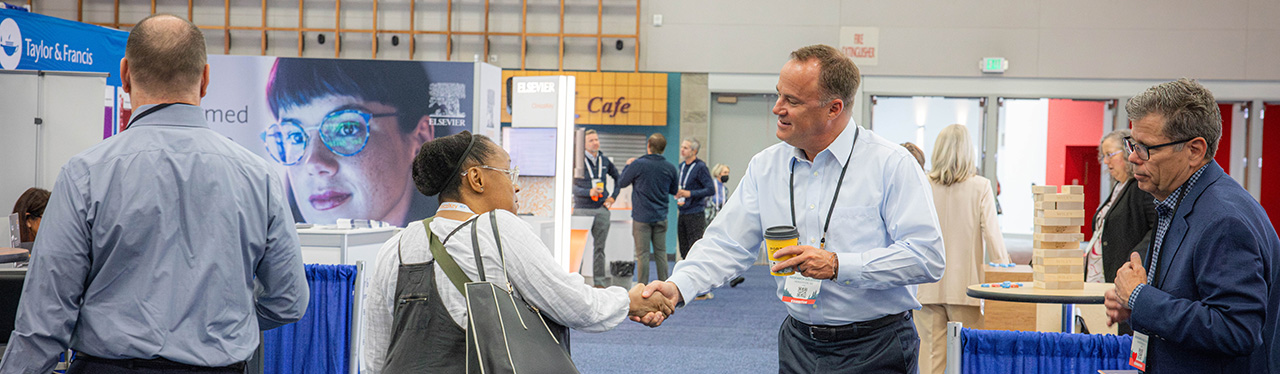
If you are attending an in-person conference (like MLA), it's a good idea to take the time to explore the expo floor.

The Medical Library Association recently posted an article that explains some of the reasons why and how a visit to the expo floor can enrich your conference experience:

  • Discovering innovative technologies and resources
  • Networking opportunities
  • Educational sessions and demonstrations
  • Staying informed about industry trends
  • Gathering info for future decisions
  • Enhancing professional development
  • Enjoying the experience
I would add a few additional points as well:

  • Take a list of questions and map out your time with the vendors in the expo hall that you want to visit. 
  • It's a chance to meet some of your/our customer service reps in person.   Most of them don't make "house calls" anymore, so it can be a blessing to meet some of them in person to build relationships.   
  • If you're having issues with any of your products, or want to recommend an enhancement, it's a chance to meet face-to-face to discuss problems and solutions.  You may be able to solve some issues with that in-person visit that have not had resolution at a distance.  Or get connected with the people who can help you.
  • There may be freebies.  For example, JAMA used to give out artsy posters. 

Sunday, April 13, 2025

Pets of WHSLA: The Sassy Hazel

 I figured I would continue the Pets of WHSLA series for my first post, as well! Let me introduce everyone to the photogenic Hazel. 

 An Irish wolfhound mix, Hazel's occupation is being a full-time couch potato (a career which she takes very seriously). She also has a side-hustle being a model, and features pretty heavily in my slide shows for health sciences students (especially her goofier photos).

When she's off the clock, she enjoys hiking and getting the occasional pup cup at a coffee shop. 

Hazel and I are so excited to be contributing to the WHSLA blog! Thanks to everyone for reading, and I hope everyone has a great day! =)

Friday, April 11, 2025

Pets of WHSLA: Lilo and Gus (plus the chicken ladies)

 As my first post on the blog, I'll continue the popular Pets of WHSLA series with my cats: Lilo and Gus

Image of two tabby cats sleeping in a cat bed
(Attempting to fit in the same bed with mixed results)

They are brother and sister from the same litter and 11.5 years old. They generally sleep a lot, but romp around with each other plenty and keep us on their schedule. Lilo will remind our son when it's time to go to bed and stare at his door if she didn't get in there before he shut it, so she can go snuggle with him. Gus will stare at the bare spot in the 3/4 full food dishes to let us know that he is just wasting away with hunger.

Cat sitting under the arm of a woman  
Woman and cat

And of course both cats love helping me work from home...

Tabby cat looking at a flock of chickens through a glass door

Bonus pets: we also have five chickens who like to observe us and the cats through the kitchen door.
Their names are: Love, Tiny, Tornado, Hen Solo, and Princess Leia


Wednesday, April 2, 2025

New voices on the WHSLA blog

The WHSLA blog is happy to welcome two new voices this spring: Paije Wilson from UW-Madison's Ebling Library and Kelly Johnson from ThedaCare Library in Appleton.

This spring, Michele Matucheski will take over as the WHSLA blog administrator and continue to post content. Brenda Fay will step down from the blogging team after a nine-year stint. Anyone remember our first blog posts from March 2016?

Get to know our new bloggers, Kelly and Paije. 


Kelly Johnson, Medical Librarian at ThedaCare Library in Neenah

Favorite midnight snack: sweet treat- brownies, but right now I’m trying to focus on protein and fiber, so likely beef jerky or prunes (which I love)! 

 My superpower would be teleportation so I could go anywhere in the world at a moment’s notice. I would love to have an instant commute or be able to pop over to the ocean for a relaxing afternoon.
 
Right now I am reading: Demon Copperhead by Barbara Kingsolver; it’s fine so far, not great, not terrible, just kind of goes along. Next up my 10 year old wants me to read Ground Zero by Alan Gratz. He’s a big fan of Allies by the same author and wants me to read something by him as well.


Paije Wilson, Health Sciences Librarian at Ebling Library, UW-Madison 

What’s your favorite midnight snack? Stove-top popcorn.

If you could choose a superpower, what would you pick?  I would love to talk to animals.

Who would you choose if you could be friends with a fictional character? That's a tough one! Maybe Bigwig from Watership Down by Richard Adams (who wouldn't want to be friends with a rabbit?)
 
What are you reading right now? The Lincoln Highway by Amor Towles

Tuesday, April 1, 2025

When Disaster Strikes: Evacuating Unicoi Hospital by Radio Advisory

RadioAdvisory No. 241: When Disaster Strikes: Evacuating Unicoi Hospital (about 34 min.)

With spring bringing turbulent weather in WI, I thought this story was fitting for WI Librarians.

The podcast is only about 30 minutes long.  It tells the harrowing story of Unicoi Hospital that had to be evacuated due to the rising storm waters of the nearby river.    Read more (including transcript).

I remember storms in WI that made the waters rise, and closed roads so I couldn't get to work some days in Oshkosh, or violent wind storms that caused power to go out through most of the city -- also closing roads due to fallen trees.   I remember floods where administrators and maintenance guys were banking sand bags to prevent the water in the run-off ponds from breaching our hospital building ...     

It could happen to any one of us.  What would you do in that situation?  Granted: Saving a Library is a whole other story, but it does help to put things into perspective about what is really important and what isn't ...  What can be replaced later, and what can't.

Friday, March 28, 2025

Free webinar: Generative AI Features in Library Resources: A Panel Discussion About What You Need to Know

 Enjoy this free webinar from ACRL.

"A panel discussion among vendors and academic librarians about generative AI in current library resources, the directions they may take in the futures, and their impact on librarianship and education. The panel includes Kathleen Flynn, University at Albany, SUNY; Eric Prosser, Arizona State University; J. Denice Lewis, Wake Forest University; Ann Benyon, Clarivate; Emily Singley, Elsevier; Ashank Rai, JSTOR; and Beth LaPensee, Ithaka. Brought to you by the STS Vendor/Publisher Relations Committee."

Tuesday, March 18, 2025

UWM's map library

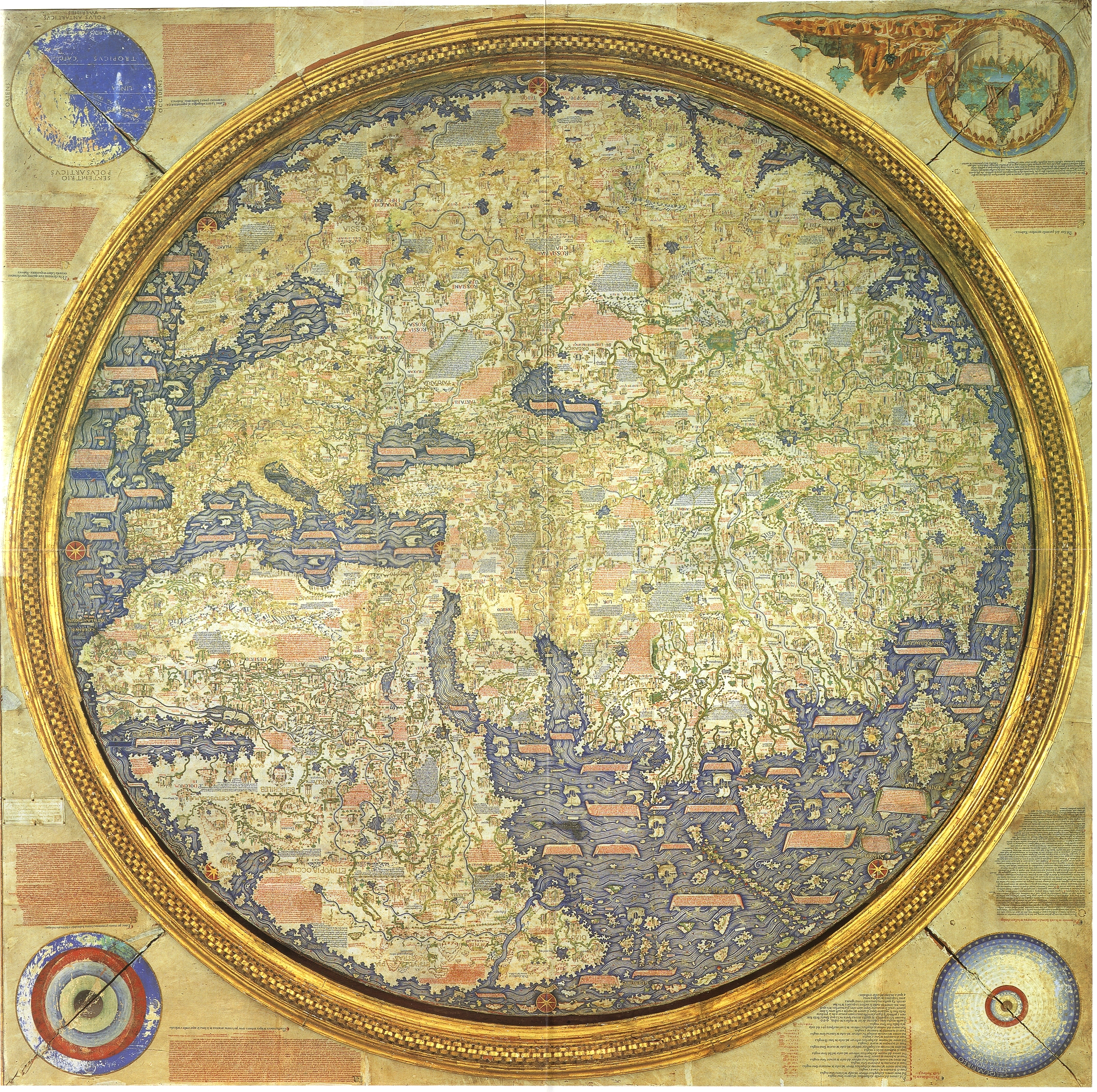
UWM's map library is in the news. One of their oldest maps will be getting digitized: Lazarus Project to shine a new light on oldest map in UWM collection

for more pictures and an interesting tidbit about a donation from Charles Lindbergh himself, check out this Atlas Obscura article about the map library: Inside the Most Amazing Map Library That You've Never Heard Of - Atlas Obscura.


Tuesday, March 11, 2025

These Words are Disappearing ...

WHSLA Member Diane Giebink-Skoglind wanted to share the following NY Times article

as this info may impact search strategies going forward:

These Words Are Disappearing in the New Trump Administration

As President Trump seeks to purge the federal government of “woke” initiatives, agencies have flagged hundreds of words to limit or avoid, according to a compilation of government documents.


  • accessible
  • activism
  • activists
  • advocacy
  • advocate
  • advocates
  • affirming care
  • all-inclusive
  • allyship
  • anti-racism
  • antiracist
  • assigned at birth
  • assigned female at birth
  • assigned male at birth
  • at risk
  • barrier
  • barriers
  • belong
  • bias
  • biased
  • biased toward
  • biases
  • biases towards
  • biologically female
  • biologically male
  • BIPOC
  • Black
  • breastfeed + people
  • breastfeed + person
  • chestfeed + people
  • chestfeed + person
  • clean energy
  • climate crisis
  • climate science
  • commercial sex worker
  • community diversity
  • community equity
  • confirmation bias
  • cultural competence
  • cultural differences
  • cultural heritage
  • cultural sensitivity
  • culturally appropriate
  • culturally responsive
  • DEI
  • DEIA
  • DEIAB
  • DEIJ
  • disabilities
  • disability
  • discriminated
  • discrimination
  • discriminatory
  • disparity
  • diverse
  • diverse backgrounds
  • diverse communities
  • diverse community
  • diverse group
  • diverse groups
  • diversified
  • diversify
  • diversifying
  • diversity
  • enhance the diversity
  • enhancing diversity
  • environmental quality
  • equal opportunity
  • equality
  • equitable
  • equitableness
  • equity
  • ethnicity
  • excluded
  • exclusion
  • expression
  • female
  • females
  • feminism
  • fostering inclusivity
  • GBV
  • gender
  • gender based
  • gender based violence
  • gender diversity
  • gender identity
  • gender ideology
  • gender-affirming care
  • genders
  • Gulf of Mexico
  • hate speech
  • health disparity
  • health equity
  • hispanic minority
  • historically
  • identity
  • immigrants
  • implicit bias
  • implicit biases
  • inclusion
  • inclusive
  • inclusive leadership
  • inclusiveness
  • inclusivity
  • increase diversity
  • increase the diversity
  • indigenous community
  • inequalities
  • inequality
  • inequitable
  • inequities
  • inequity
  • injustice
  • institutional
  • intersectional
  • intersectionality
  • key groups
  • key people
  • key populations
  • Latinx
  • LGBT
  • LGBTQ
  • marginalize
  • marginalized
  • men who have sex with men
  • mental health
  • minorities
  • minority
  • most risk
  • MSM
  • multicultural
  • Mx
  • Native American
  • non-binary
  • nonbinary
  • oppression
  • oppressive
  • orientation
  • people + uterus
  • people-centered care
  • person-centered
  • person-centered care
  • polarization
  • political
  • pollution
  • pregnant people
  • pregnant person
  • pregnant persons
  • prejudice
  • privilege
  • privileges
  • promote diversity
  • promoting diversity
  • pronoun
  • pronouns
  • prostitute
  • race
  • race and ethnicity
  • racial
  • racial diversity
  • racial identity
  • racial inequality
  • racial justice
  • racially
  • racism
  • segregation
  • sense of belonging
  • sex
  • sexual preferences
  • sexuality
  • social justice
  • sociocultural
  • socioeconomic
  • status
  • stereotype
  • stereotypes
  • systemic
  • systemically
  • they/them
  • trans
  • transgender
  • transsexual
  • trauma
  • traumatic
  • tribal
  • unconscious bias
  • underappreciated
  • underprivileged
  • underrepresentation
  • underrepresented
  • underserved
  • undervalued
  • victim
  • victims
  • vulnerable populations
  • women
  • women and underrepresented

Notes: Some terms listed with a plus sign represent combinations of words that, when used together, acknowledge transgender people, which is not in keeping with the current federal government’s position that there are only two, immutable sexes. Any term collected above was included on at least one agency’s list, which does not necessarily imply that other agencies are also discouraged from using it. 

Friday, March 7, 2025

NNLM Traveling Exhibit now at Marquette's Raynor Library


 Marquette will host “This Lead is Killing Us: A History of Citizens Fighting Lead Poisoning in their Communities,” which explores how citizens, scientists and medical professionals have confronted industry to protect their health against the dangers of lead poisoning, beginning March 10 and running through April 19 at Raynor Library. 

Lead exposure can cause neurological problems, even death — especially in children. Despite this, the metal has been pervasive in many aspects of life in Milwaukee and the rest of the United States for more than a century. Many industries added lead to their manufacturing processes and products, endangering their workers and putting communities at risk through polluted air, contaminated water and paint dust. 

This Lead is Killing Us” is produced by the National Library of Medicine and features photographs, advertisements, newspaper articles, official reports and other materials that reveal how and when lead has hurt Americans’ health and shines a light on milestone civic actions that have protected communities against this environmental danger. 

The National Library of Medicine offers a variety of online companion materials: 

  • Exhibition highlights, including historical materials shown in the exhibition 
  • Educational resources for K-12 educators, including lesson plans 
  • Digital gallery with related historical materials, including scientific reports and public service announcements, on the dangers of lead 

This exhibit is free and open to the public during the library’s regular visitor hours.