A blog from WHSLA (Wisconsin Health Sciences Library Association) featuring posts on medical and health science libraries, NLM, and learning opportunities for medical and health science librarians and library staff.
This past spring my family visited Mount Vernon. We marveled at the gardens and architecture, learned about education at Mount Vernon, and the enslaved and free people that worked on the estate.
Since then I've been reading more about Revolutionary War era America and ran across some interesting posts on medicine in the late 1700's. As always when you read about medicine more than 200 years ago, it makes me glad I am alive in the 21st century.
Read more below about George Washington's health throughout his life, how his family was touched by cancer, meet his good friend Dr. James Craik, and learn what might have been inside an 18th century medicine jar.
Friday afternoon of the WHSLA conference featured a fireside chat with Dr. Brian Patterson, Associate Professor and Medical Informatics Director for Predictive Analytics and Clinical Decision Support, UW Health.
Dr. Patterson shared his knowledge of artificial intelligence including large language models (LLMs) such as ChatGPT and how they have evoloved over time and will continue to evolve.
What are
people doing with AI in Medicine? People are
using 3rd party apps on the web like Nabla Copilot, DocsGPT. Many
companies have outlawed these tools *, but people will be using them anyway on
their personal devices because they see the value in it.
Dr. Patterson
expects there will eventually be integration with existing IT products --
including the EPIC project that you mentioned--as businesses license closed
shop versions that won't recycle and sell company secrets.
He suggested
that AI would be more of a trust-but-verify copilot, "like a book-smart
intern who comes in hung-over sometimes" vs. "the crystal ball is
broken if it doesn't always get the right answer."
ChatGPT for discharge instructions
Drs will spend less time on documentation and other drudge work, which may
reduce burnout
These tools make it very easy to draft content, but the end-user is
still responsible for the final draft.
During the Q&A portion questions were posed about the reliability of ChatGPT especially in regards to citing accuracte evidence and not hallucinating (i.e. making up citations). This is something that ChatGPT might get better at in the future, but human authors using LLM tools will always need to verify, confirm, and attest to the content they create with the help of ChatGPT.
Dr. Patterson shared that he has been surprised that the uptake and interest in adopting new LLM technologies has happened as quickly as it has. Right now UW-Health is working with Epic to use AI: UW Health using Microsoft AI in Epic Systems medical records (news article). It's likely that more and more health systems will allow uses of AI as the technology evolves and the benefits are seen. One area Dr. Patterson hopes AI can help with is by decreasing paperwork burdens such as charting on providers. An April 5, 2023 story on NPRtalked about just that.
For our MLA continuing education offering, the planning committee asked Abby Dowd to design a new 90-minute class for WHSLA about using ADDIE for instructional design.
Learners got practice working through a scenario to analyze the need for the new class, develop goals and objectives (the blueprint) and develop the class using a storyboard model to flesh out the course.
Having a framework / road map made it easier to map out the class.
The session was recorded and will be freely available for current WHSLA Members on our website.
Badgerlink is Wisconsin's online library, serving ALL citizens of Wisconsin, from school kids to college students to professionals in the workforce. With over 60 databases in the Badgerlink collection, there's something for everyone!
Dr. Bob McGrath, a noted psychologist, specializing in mind/body wellness at UW Madison Health Services was our keynote speaker for the WHSLA Web Conference 2023.
Dr. McGrath started his talk by asking: What's most important in our lives?
Relationships & Connections
Doing for others - Those who help others are happier.
Commit to BE with those you feel close to in a media-free zone
Here are some of Dr. McGrath's tried and true tips for dealing with stress:
Breathing is the best way to chill out. He recommended 4-7-8 breathing.
Gratitude - Be Thankful - Keep a gratitude journal - Send a thank you note.
Mindfulness - Be in the moment - Be present and non-judgmental.
Take care of your body - Drink enough water; Eat better; No soda;
Get a good night's sleep - No caffeine after 2 pm - Limit blue light (screen time) before bed
Move - Take a brisk walk for 15-20 min. a day.
Laugh
Get out in Nature
My own conclusion from the talk was that a dog would be the best companion for mind-body wellness, because they provide non-judgmental companionship, daily reason to exercise and get out in nature, and laughter.
If you want to read more, Dr. McGrath recommends the following books:
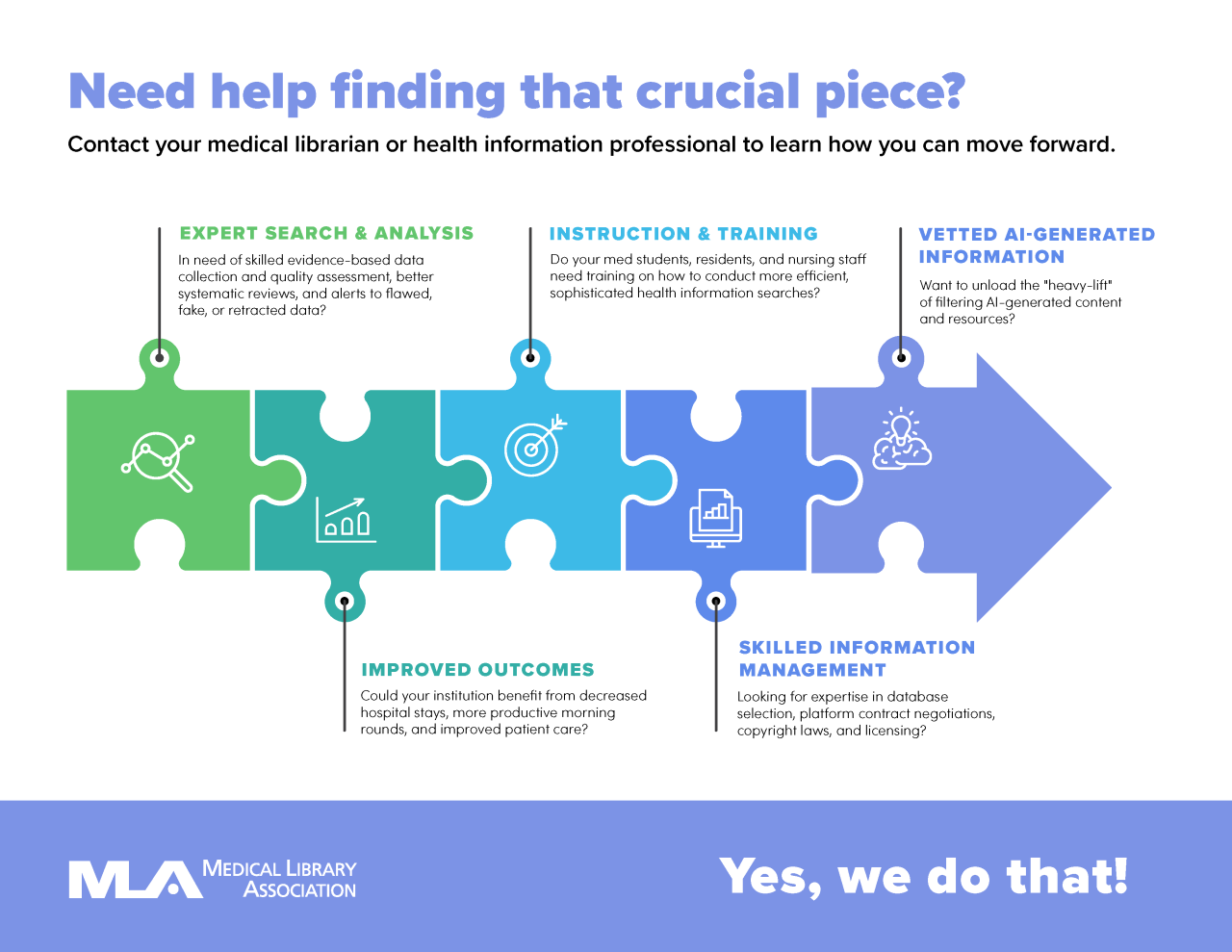
Medical librarians work tirelessly to support healthcare providers, researchers, and patients for evidence-based medical knowledge. The month of October is recognized as National Medical Librarian Month (NMLM) to celebrate and highlight these dedicated professionals and their achievements.
Behind the scenes of healthcare and hospitals are a group of unsung heroes who play a pivotal role in facilitating research and quality health information – you, medical librarians and health information professionals. Ask your library users if they need help with
Expert searching
Information management
Instruction & training
And let them know to reach out because as this year’s theme says it loud and clear –
Yes, we do that!
See the Medical Library Association for more info about how to celebrate NMLM at your institution, including printable posters and email sigs.
We are now accepting nominations for the upcoming Wisconsin
Health Sciences Library Association Board openings for 2024. All members are
eligible for board positions. If you have not recently been a part of the
WHSLA Board, please consider serving.
Positions on the ballot:
President-Elect 2024-President 2025 The
president-elect shall function in the absence of the president, assist the
president as needed, and succeed to the presidency after one year. If the
office of president is vacated, the president-elect shall assume all the duties
and responsibilities of the president. The president shall call meetings,
prepare agenda, preside at meetings, appoint or approve committee members, and
represent the association in all official capacities. The president shall serve
as an ex-officio member of all committees.
Secretary 2024-2025 The secretary shall record the
minutes of all meetings, submit copies of the minutes to the executive board,
and be responsible for meeting notices and correspondence. The secretary shall
serve for two years. The term for secretary begins in even numbered years.
Terms can be counted towards AHIP credentialing when
tallying your Professional Accomplishment Points. For a multi-year term, you
may claim points after each full year of service.
Please reach out if you have any questions or if you would
like to be listed as a candidate for one of the open roles on the ballot.
The Election will take place by Online Ballot on December
1st, 2023.
In this video, Wharton Interactive's Faculty Director Ethan Mollick and Director of Pedagogy Lilach Mollick discuss how to effectively prompt AI like Midjourney, ChatGPT, Microsoft’s Bing, as well as how to take the lead, weaving your own expertise into the interaction.
This video is Part 3 of a five-part course in which Wharton Interactive provides an overview of AI large language models for educators and students. They take a practical approach and explore how the models work, and how to work effectively with each model, weaving in your own expertise. They also show how to use AI to make teaching easier and more effective, with example prompts and guidelines, as well as how students can use AI to improve their learning.
MM: This is the part of AI that is so interesting to me: How to get it to do what you want it to do?
Prompt engineering — the practice of improving your prompts to AI models such as ChatGPT — may sound complicated, but it's easier than you think. Here are five tips to get you started from Advisory Board's Thomas Seay.
1) Give examples of your desired output.
2) Ask the AI to adopt the role of a specific expert.
3) Explain how the AI's reply will be used.
4) Ask the AI to think step-by-step.
5) Ask for multiple responses.
Read the story for more details on each of the 5 points above.
Our fall 2023 conference schedule for September 29th, 2023 is now available and registration for the event is open!
This event is FREE for, and only open to, WHSLA members and current Library Information Students. If you're not a member, you can join or renew for just $20.
Highlights include:
Keynote Speaker Dr. Bob McGrath on Thriving – In the Midst of Change
Resources presentation from BadgerLink
NNLM update
and a brand new MLA CE Webinar: Strategic Course Design for Librarians- Unpacking the Power of ADDIE with NNLM Training and Development Specialist Abby Dowd, M.Ed.
In addition to those exciting presentations we'll also have a more casual fireside chat on AI in Medicine with Dr. Brian Patterson. This will build off our spring WHSLA wisdom chat discussing the pitfalls and benefits of ChatGPT.
>>> If you have any questions or topics for Dr. Patterson, please submit them to me, Liz Witkowski, via email witkowskilm@gmail.com.
We look forward to your attendance and are excited to share this day of professional development with you!


.png)