Showing posts with label Evidence-based practice. Show all posts

Thursday, November 7, 2024

The Evidence Pyramid Problem [ NNLM Webinar]

The Evidence Pyramid Problem  : NNLM Webinar from October 2024

This recent NNLM webinar made me re-think the EBP Pyramid.  We know there are multiple PICO-type models for different types of questions.  It only stands to reason that different questions might require different EBP Pyramids, too.   


In 2022, The Journal of PeriAnesthesia Nursing launched a series focused on revolutionizing processes for evidence-based practice (EBP). This series aims to identify longstanding EBP-related traditions that may be outdated or unsupported by evidence, or may simply add confusion, poor scholarship, and workload burden. 

In this webinar, the authors of the latest article in this series will join us to discuss the evidence pyramid. They will provide an overview of how the traditional evidence pyramid can mislead students and clinicians, and propose a different method to determine evidence strength and applicability – the evidence funnel. Join us for an engaging session that will feature a live discussion, with ample opportunity for questions and dialogue.

Guest Speakers

Laura Cullen, DNP, RN, FAAN leads Evidence-Based Practice at University of Iowa Health Care. Laura is internationally recognized for her expertise in EBP and implementation. Among her many accomplishments, she is most proud of the many clinicians she has mentored and staying application oriented. Laura’s work has led to innovation in practice; improved patient safety; reduced nosocomial events; improved patient, family and staff satisfaction; reduced hospital LOS and costs; and transformation of many organizations’ EBP infrastructure.  She has over 100 publications and presents nationally and internationally. Laura is on the editorial board for and has a regular EBP column in the Journal of PeriAnesthesia Nursing, and is on the editorial board of the American Journal of Nursing, and has been on the grant review panel for the DAISY Foundation.  She has received multiple awards and her work supported numerous awards for the nursing department.

Dr. Stephanie Edmonds is the Nurse Scientist at Abbott Northwestern Hospital in Minneapolis and an Associate Adjunct Faculty at the University of Minnesota School of Nursing. She currently leads evidence-based practice programs at Abbott Northwestern, with over five years of experience leading nursing teams in healthcare improvement work. Dr. Edmonds’s research centers on healthcare improvement with a particular interest in implementation science, patient engagement, and patient-centered communication.

Jennifer DeBerg, OT, MLS,  is a User Services Librarian at the Hardin Library for the Health Sciences at the University of Iowa Libraries. In this role, she leads a user services team for ongoing assessment and quality improvement of library services and provides regular direction to the reference team. She also serves as liaison to nursing, orthopedics, rehabilitation therapies, and communication sciences. Prior to obtaining her MLS in 2008, Jennifer worked as an occupational therapist for 15 years, and has a passion for providing support/education to clinicians with an interest in evidence-based practice. Research interests include nurse practitioner use of EBP, library user experience, and healthy library workplace design. 

Objectives:
    1. Stimulate critical thought about evidence base-practice and provide a forum for a thoughtful discussion.


Friday, July 23, 2021

PubMed Update: Clinical Queries Usability Study and Interface Updates


PubMed Update: Clinical Queries Usability Study and Interface Updates

The PubMed Clinical Queries interface has been updated following a usability study to support user-friendly, efficient searching on clinical and disease-related topics. Clinical Queries currently includes filters for Clinical Studies and COVID-19 articles; the search strategies for these filters did not change in this update.

Clinical Queries Usability Study

The National Library of Medicine (NLM) recently conducted a usability study of the PubMed Clinical Queries interface to:

  • Explore user goals for conducting searches with Clinical Queries
  • Identify strengths and weaknesses of the original interface
  • Recommend improvements to help users search more confidently and efficiently when using PubMed Clinical Queries
  • Create a flexible page design that can adapt to and support emerging needs in the future, such as the addition of COVID-19 filters in fall 2020 (see PubMed Clinical Queries Update Coming Soon)

The usability study gathered input from librarians, clinicians, researchers, and other PubMed users through video interviews, hands-on testing, survey responses, and web analytics. Many thanks to the participants for sharing their time, feedback, and expertise to help improve PubMed!

Searching with PubMed Clinical Queries

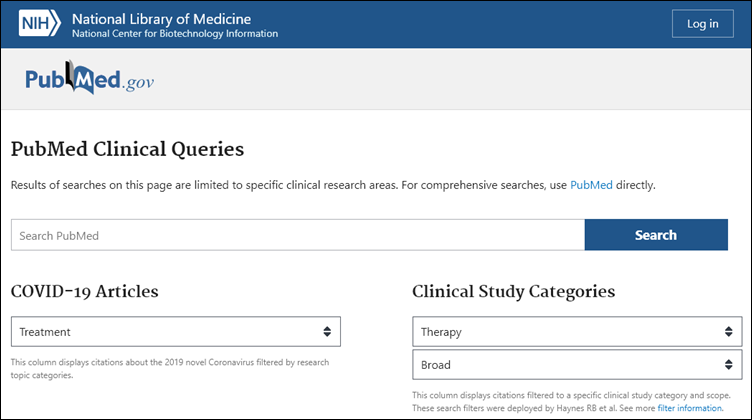
Based on user feedback, the Clinical Queries interface (see Figure 1) has been streamlined to focus on one search category at a time, facilitate quick access to the full results in PubMed, and make supporting information about the filters and results more readily accessible. Please note, the Clinical Queries filters have not changed in this update; these filter search strategies are documented in the PubMed User Guide.


Figure 1: The PubMed Clinical Queries interface has been updated to support user-friendly, efficient searching.

To search using Clinical Queries:

  1. Enter your search terms in the search bar.
  2. Adjust the Filter category and selected Filter(s) as needed.
  3. Changing filter settings will automatically search with the new filter applied, or you can use the Search button to manually run your search.
  4. Preview the first five results for your search on the Clinical Queries page.
  5. To view all results, click the link to "See all results in PubMed."

NLM is continuing to enhance the PubMed user experience based on usability testing, analytics, and feedback from users. Please write to the Help Desk with your comments and suggestions.

By Jessica Chan
National Center for Biotechnology Information

__________________________________________________________________________

This article first appeared in the NLM Technical Bulletin on July 20, 2021.  It is reprinted here courtesy of the US National Library of Medicine.

Chan J. PubMed Update: Clinical Queries Usability Study and Interface Updates. NLM Tech Bull. 2021 Jul-Aug;(441):e3.   Link to article.  

Friday, October 16, 2020

PubMed Clinical Queries Update to Include a Covid-19 Search for Best Evidence

 The PubMed Clinical Queries page will soon be updated with design and content changes. The new page design aligns with the new PubMed and includes a new category for COVID-19 searches. Links and bookmarks created for the legacy PubMed Clinical Queries page will be redirected to the new page when this change takes effect.

The PubMed Clinical Queries page will initially include COVID-19 Articles and Clinical Study Categories (see Figure 1). The new COVID-19 filter strategies are published in the PubMed User Guide and may evolve over time.


Figure 1: PubMed Clinical Queries Page.


The Systematic Review and Medical Genetics filters that were included in the legacy PubMed Clinical Queries page have moved:

  • Systematic Review is available as a default Article Type filter on the filter sidebar for PubMed search result pages (see Figure 2).
  • The Medical Genetics searches are available as filters that may be added to a query using the filter name with the search field tag [filter]: for example, sickle cell anemia AND genetic counseling[filter]. The complete list of filters and associated search strategies are published in the PubMed User Guide.


Figure 2: PubMed Article Type Filter.

For more information about using Clinical Queries and the filter strategies, please see the PubMed User Guide:

By Jessica Chan
National Center for Biotechnology Information

Originally posted to the NLM Technical Bulletin on October 14, 2020.

Chan J. PubMed Clinical Queries Update Coming Soon. NLM Tech Bull. 2020 Sep-Oct;(436):e8.

Friday, June 26, 2020

Using PubMed in Evidence-Based Practice: New Tutorial Available


The Using PubMed in Evidence-Based Practice tutorial is available now from the PubMed Online Training page on the NLM Web site. 

  • This tutorial was created to help clinicians including nurses and allied health professionals develop a clinical question using the PICO framework and efficiently find relevant biomedical literature using PubMed. 

  • The tutorial was designed to be completed in less than 30 minutes. 
  • This tutorial replaces the PubMed for Nurses tutorial.


Using PubMed in Evidence-Based Practice: New Tutorial Available. NLM Tech Bull. 2020 May-June;(434):b5.

This brief article was originally published in the NLM Technical Bulletin.  It is reprinted here because the content is not copyrighted and is freely reproducible.

Monday, May 18, 2020

Rough Guide to Spotting Bad Science: Infographic


From Compound Chem:  "This graphic looks at the different factors that can contribute towards ‘bad’ science – it was inspired by the research I carried out for [a different project,] where many articles linked the compound to causing breast cancer, referencing scientific research which drew questionable conclusions from their results."  Read more ...

Monday, April 27, 2020

TWIV Podcast: Evidence-Based Science and Medicine for Covid-19: TWIV 606


TWIV 606: Evidence-Based Science and Covid-19 [Listen to the podcast; get more info and links mentioned in the episode.]


As a Medical Librarian living and working in the current time of Coronavirus,  I've been struggling with what to send people asking for research on Covid-19, when the best available "evidence" is only just emerging and appears on pre-print servers and hasn't had time to perk through all the usual peer review and filters of fully-formed evidence-based practice.  In other words, it's not what we're used to as gold-standard evidence.  What we are seeing is much lower on the evidence pyramid. 

On the one hand, it's an exciting time to see the research emerge and evolve, to witness so many people around the world working to solve this emerging and evolving pandemic-sized infectious disease. It's also more than a little alarming to see the state of the evidence ...

Researchers and physicians are willing to try something/anything if it might help solve some small part of the Covid-19 puzzle.  If they put together very small studies with no control to compare outcomes, what is that study really worth?   

I'm not the only one with these concerns, which is why I was glad to see the TWIV podcasters addressing this topic.   Give it a listen ...    at least the first 45 minutes where
Dr. Daniel Griffin gives a nice description of how physicians make decisions, running the gamut from the ultimate goal of evidence-based practice to all these other varieties we've seen since the onset of Covid-19: 

  • Experience-based medicine (including experience bias)
  • Vehemence-based medicine
  • Eloquence-based medicine (More spin than science.)
  • Diffidence-based medicine ("No good answers here.")
  • Defensive-based medicine
  • Careful observation and experience based medicine 
    • Did it help or hurt?  Stand there and think about it.  Did it work?
  • Evidence-based medicine
Always remember, Physicians are human.  They are subject to the same stress and overwhelm everyone else gets.  Early on in this pandemic, there was an emotional, anxious, desperate response to do something/anything to make a difference in outcomes for Covid patients.  Do everything and see what sticks ...   Now Dr Griffin's advice is to "Don't just DO something: Stand there ... and see if it worked."

What are you listening to to keep up with Covid-19 developments?