Showing posts with label systematic reviews. Show all posts

Tuesday, September 23, 2025

Post by Jannette Bradley, Former Recipient of the WHSLA Professional Development Award!

 As a former recipient of the WHSLA Professional Development award, I am happy to acknowledge that I have completed the coursework for the Level Two Certificate in the Systematic Review Services Specialization. This specialization is sponsored by the Medical Library Association which seeks to enhance the expertise and skills of health information professionals. I used the award to fund the specialization courses. My journey, which began around 2019-2020, has been both challenging and rewarding. I have gained valuable insights into the librarian's role in systematic reviews and am excited to apply these principles when assisting my patrons.

When I started way back in the "olden times" of 2020s, it seemed there were somewhat limited resources available for librarians to enhance their skills in systematic reviews. The University of Michigan course and the course on designing search strategies offered by Washington University were among the primary options. Today, I am thrilled to see the growing number of educational opportunities in this field. This expansion allows librarians not only to strengthen their skill sets but also to elevate the quality of their contributions to research teams.

Through this coursework, I have sharpened my ability to draft complex and reproducible search strategies, an essential skill both for systematic reviews and for the wide range of literature review requests I receive day to day. I have also become more confident in clearly describing the systematic review process to researchers and students, helping them understand where a librarian’s expertise can make a measurable impact on the rigor and transparency of their review.

I am especially looking forward to using new tools in my daily work—not only for systematic reviews but also for narrative reviews, as well as for everyday research consultations. Some of the webinars I have attended during this training, for example, highlighted emerging AI-based tools designed to support various phases of the review process. Learning to critically evaluate these tools and integrate them into my workflows has given me a broader perspective on how librarians can enhance efficiency while maintaining quality and standards.

We are considering how AI tools might be thoughtfully integrated into our research workflows. Included among the courses on offer for this specialization was a session led by Gregory Laynor, “Communicating with Researchers about the Benefits and Risks of AI for Evidence Synthesis.” It was especially thought-provoking and offered useful perspectives for engaging with patrons and colleagues on this evolving topic.

Overall, this certification validates the progress I have made as a professional and represents my ongoing commitment to supporting evidence-based practice. It equips me with both foundational and advanced approaches that I will now apply in my institution when collaborating with patrons. I am grateful for the support of this award, which has allowed me to continue growing in this specialized area of medical librarianship.

Friday, November 8, 2024

Piecing Together Systematic Reviews - Part 4: Paper

Piecing Together Systematic Reviews - Part 4: Paper   

An NNLM Webinar from Sept. 25, 2024


This session will cover the fourth phase of the PIECCESS review cycle, the Paper phase, during which the report is written. This will cover updating searches, selecting the journal, writing search reports, and other potential support.

Speaker Information

Margaret Foster, MS, MPH, is the Evidence Synthesis and Scholarly Communication Librarian and the Head of the Center for Systematic Reviews and Research Syntheses at the Medical Sciences Library, Texas A&M University. She is the co-author of the first book written on systematic reviews for librarians- Assembling the Pieces of a Systematic Review: A Guide for Librarians (2017) and recently Piecing Together Systematic Reviews and Other Evidence Syntheses (2022). She received the Presidential Impact Award from Texas A&M University in 2018 and the Lucretia W. McClure Excellence in Education Award in 2024 from the Medical Library Association.

This presentation meets the NNLM goal to work through libraries and other members to support a highly trained workforce for biomedical and health information resources and data, improve health literacy, and increase health equity through information.

 This class is for educational and informational purposes in alignment with NNLM goals and does not offer medical advice.


Class Resources:
Objectives:

At the end of this session, participants will be able to:

    • Describe standards for reporting searches
    • List potential options for librarian input into written reports of reviews
    • Describe when and how to update searches


Sunday, September 8, 2024

Piecing Together Systematic Reviews: Part 3 Production [NNLM Webinar]


Piecing Together Systematic Reviews. Phase 3: Production, an NNLM Webinar that took place on August 28, 2024.

Additional class materials can be found on the event page.


This session will cover the third phase of the PIECCESS review cycle, the Production phase of conducting a systematic review, during which the searches are completed. This will cover evaluating searches, translating between databases, deduplication, and grey literature.

The five-part series will introduce the review cycle framework, PIECCESS, as described in the book by Foster and Jewell (2022) Piecing Together Systematic Reviews and Other Evidence Syntheses. Throughout the phases, the potential roles for librarians, health care professionals and others interested in the process of systematic review will be discussed as well as categories of client, such as those who read reviews as compared to those who conduct reviews.

Speaker Information

Margaret Foster, MS, MPH, is the Evidence Synthesis and Scholarly Communication Librarian and the Head of the Center for Systematic Reviews and Research Syntheses at the Medical Sciences Library, Texas A&M University. She is the co-author of the first book written on systematic reviews for librarians- Assembling the Pieces of a Systematic Review: A Guide for Librarians (2017) and recently Piecing Together Systematic Reviews and Other Evidence Syntheses (2022). She received the Presidential Impact Award from Texas A&M University in 2018 and the Lucretia W. McClure Excellence in Education Award in 2024 from the Medical Library Association.

This presentation meets the NNLM goal to work through libraries and other members to support a highly trained workforce for biomedical and health information resources and data, improve health literacy, and increase health equity through information.

Wednesday, January 11, 2023

Opinion on "rapid" reviews vs systematic reviews

 A colleague shared this with me, and I thought the broader WHSLA community would appreciate it, too. 

The Dark Side of Rapid Reviews: a Retreat from Systematic Approaches and the Need for Clear Expectations and Reporting 

The authors’ opinion piece from Annals of Internal Medicine lobbies to change the language about “rapid reviews” which omit key methods for systematic science.  They point out these reviews should be known as restricted reviews or partial systematic reviews.  They ask for funding agencies and journals to limit these partial reviews unless well  justified and disclose methods ( or lack of  them) transparently. They fear if more “rapid reviews” proliferate, we will return to poor and sloppy reporting and more confusion about the science reported to the public.   This is a good article to refer to when patrons indicate they are undertaking rapid reviews.   As librarians, we should teach the value of methodical (and yes time consuming)  approach which is transparent.   Ultimately it will improve the chances of publication and is a better contribution to evidence based knowledge.


https://www.acpjournals.org/doi/10.7326/M22-2603
The Dark Side of Rapid Reviews: A Retreat From Systematic Approaches and the Need for Clear Expectations and Reporting | Annals of Internal Medicine (acpjournals.org)


Thursday, January 20, 2022

MLA Webinar: Using EndNote for Librarian-Mediated Systematic Review Searches

Image from Pixabay.

WHSLA has received funding from NNLM Region 6 for the upcoming MLA Webinar:

Using EndNote for Librarian-Mediated Systematic Review Searches.

  •  The webinar will take place on January 25th from 1:00-2:30pm, central time.   

If you would like a code for an individual to view the webinar (live or as a recording for up to 180 days) and also claim CE credits, please email Dora Davis at dora dot davis at phci dot org. 

Thank you!

Dora Davis

WHSLA Professional Development Coordinator

New Year's Resolutions & Professional Development


From Dora Davis

Your WHSLA Professional Development Coordinator


If you’re like many people, the new year is a great time to refocus and recharge.  Many of us like to make New Year’s resolutions but if you’re like me, at this mid-point in the month your steam is starting to give out to the pressures of home, work, family etc.  One resolution I’ve set for myself is to try to do at least one “official” professional development activity every month.  What better way to do that than to attend one of MLAs webinars, sponsored by Region 6?


I know some of you may be thinking that this is cheating because I’m the Professional Development Coordinator but the truth is, I haven’t found the latest MLA offerings pertinent to my super limited job as a hospital librarian.  But then a few months ago, I happened to be free and online when one of the systematic review webinars was about to start and though I don’t work on these at all in my role, I decided to log on and watch rather than continue binge watching whatever I was watching at the time.  (Right now it’s Home on Apple TV if you ‘re interested.)  So I fired up the systematic review webinar and then watched and marveled as I learned so much that I could apply to my job:  

  • I learned about being an advocate for myself and my skills, 
  • I got a refresher on Prospero 
  • and at the end of the webinar I had more than a few ideas jotted down to apply to my current position. 

Now unless I leave my organization I don’t anticipate ever working on a systematic review, however I still feel that the 90 minutes I spent in that webinar was value added to my current role.  So I will watch a webinar or attend a professional development activity every month, even if it’s a past webinar and I can’t claim credit.  (And if you’re interested in watching past webinars, I know a girl who can help with that…me!)


On the non-professional side of resolutions, I am making reading-for-pleasure a priority this year.  My goal is to read 75 books.  I’m on book 4 so wish me luck with that one!


What are your New Year’s Resolutions?


Dora 


PS-If you’re looking for a list of webinars available you can email me and I’ll send you the list.  Or you can check this blog post for a list with a few of them.

Friday, October 16, 2020

PubMed Clinical Queries Update to Include a Covid-19 Search for Best Evidence

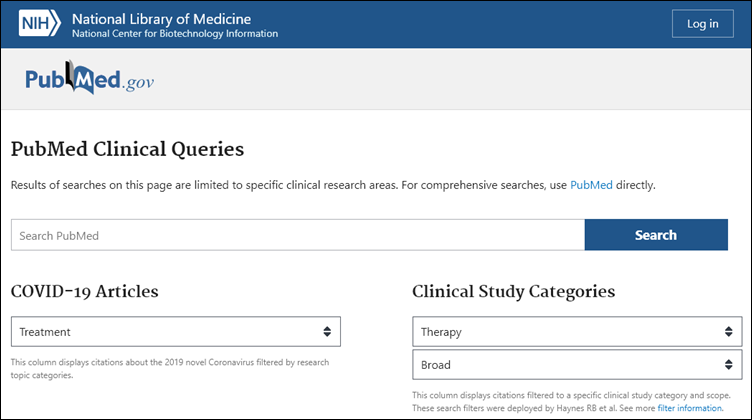
 The PubMed Clinical Queries page will soon be updated with design and content changes. The new page design aligns with the new PubMed and includes a new category for COVID-19 searches. Links and bookmarks created for the legacy PubMed Clinical Queries page will be redirected to the new page when this change takes effect.

The PubMed Clinical Queries page will initially include COVID-19 Articles and Clinical Study Categories (see Figure 1). The new COVID-19 filter strategies are published in the PubMed User Guide and may evolve over time.


Figure 1: PubMed Clinical Queries Page.


The Systematic Review and Medical Genetics filters that were included in the legacy PubMed Clinical Queries page have moved:

  • Systematic Review is available as a default Article Type filter on the filter sidebar for PubMed search result pages (see Figure 2).
  • The Medical Genetics searches are available as filters that may be added to a query using the filter name with the search field tag [filter]: for example, sickle cell anemia AND genetic counseling[filter]. The complete list of filters and associated search strategies are published in the PubMed User Guide.


Figure 2: PubMed Article Type Filter.

For more information about using Clinical Queries and the filter strategies, please see the PubMed User Guide:

By Jessica Chan
National Center for Biotechnology Information

Originally posted to the NLM Technical Bulletin on October 14, 2020.

Chan J. PubMed Clinical Queries Update Coming Soon. NLM Tech Bull. 2020 Sep-Oct;(436):e8.