Showing posts with label Covid-19. Show all posts

Tuesday, December 7, 2021

Dear Pandemic: Those Nerdy Girls Fighting Misinformation via Social Media During the Covid-19 Pandemic

Those Nerdy Girls: Fighting Misinformation via Social Media During the Covid-19 Pandemic (about 1 hour)

Nursing Ethics Special Interest Group 11/27/2021

If you missed the keynote at the joint 2021 Midwest/MCMLA Joint Annual Meeting in October, you can still get the gist of the session as Aparna Kumar, Ashley Ritter, and Shoshana Aronowitz talk about the Dear Pandemic Project in this 1-hour session.

Their goal was to provide the public with facts about COVID-19 in the face of rampant misinformation. 

Annie first introduced Dear Pandemic on The WHSLA Blog back in January 2021.

Monday, September 20, 2021

How do vaccines work?

Want a simple explanation of what vaccines do inside your body to protect you from serious illness?  Then check out this adorable short animation by Ask Ken Tay.


Coronavirus comics from University of Nebraska: meet Graffiti Mouse, Cat, and Professor Gray

Recently I ran across a post from McGoogan Health Science Library on a Coronavirus comics exhibit at their library. Happily I discovered access to these comics isn't limited as all are online, including a comic on C'rona from an indigenous perspective. 

More on the online exhibit from the McGoogan News blog... 

"In collaboration with virologists and artists, three comic stories about COVID-19 were developed during the pandemic and posted online during the last half of 2020. The fictional narratives address fundamental issues in biology, virology and network science in order to help readers understand the complexities of living through a viral pandemic.

The stories focus on three themes: the biology and social context of the COVID-19 virus; the relationship of wild animals, particularly bats, to the pandemic; and the impact of the pandemic on Tribal communities. The stories are posted online and are published by the University of Nebraska Press as the book “C’RONA Pandemic Comics,” which includes essays for youth about the virus and the pandemic.

“Tribal” features the story of Susan LaFlesche Picotte, MD, who also is featured in an exhibit in the Wigton Heritage Center."

https://worldofviruses.unl.edu/


Tuesday, August 3, 2021

How the Coronavirus Infects Cells - and why Delta is so Dangerous


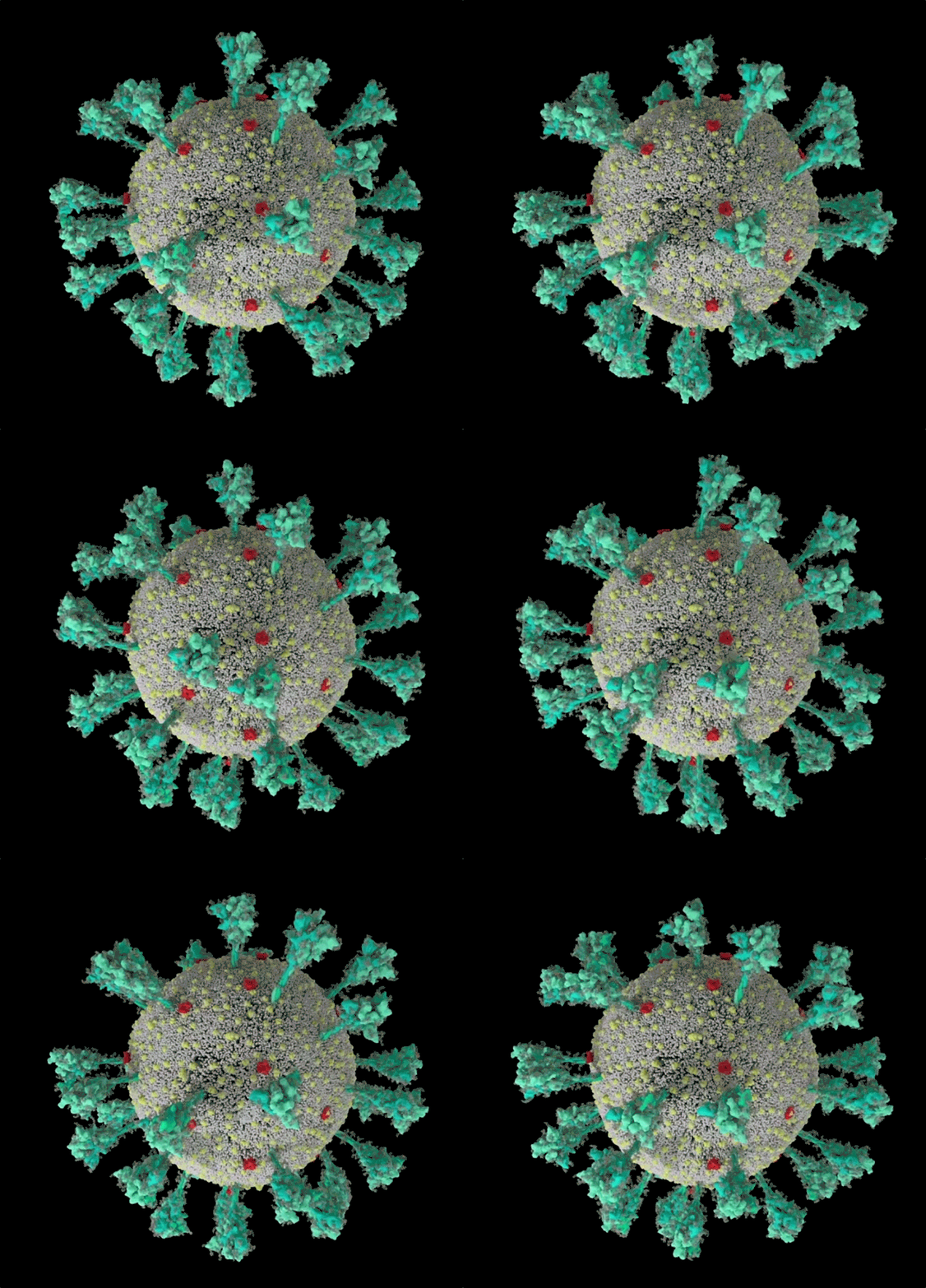
A computer simulation of the structure of the coronavirus SARS-CoV-2.Credit: Janet Iwasa, University of Utah


Nature recently posted a fascinating article about how the coronavirus infects cells-- and why Delta is so dangerous.

The article features an animated SARS-Cov-2 cell, the stalks of the spike proteins waving as if they were in a parade ...  There are several other illustrations to help explain this thing that has the world in it's thrall at the present moment.  

It's a 15-minute read.

Scudellari, M. (2021, July 28). How the Coronavirus INFECTS cells - and why delta is so dangerous: Scientists are unpicking the life cycle of SARS-CoV-2 and how the virus uses tricks to evade detection. Nature News. https://doi.org/10.1038/d41586-021-02039-y

Friday, July 16, 2021

The Librarian Reserve Corps


I've been fascinated with
The Librarian Reserve Corps ever since I first heard about it sometime last year.  It showed the value and solutions Health Science Librarians brought to the pandemic.  It made me proud to be part of this profession!

The Librarian Reserve Corps formed as a volunteer organization in response to the Covid pandemic and the World Health Organization (WHO) needing the expert skills of Librarians to help search, organize, and manage the unprecedented onslaught of new data that was coming out on the topic.

2 recent articles have been published about The Librarian Reserve Corps:

Librarian Reserve Corps: Literature indexing and metadata enhancement (LIME) observations from a year in the field

Jessica Callaway

Journal of Health Information and Libraries Australiasia; April 2021: 2(1); 35-45.


The Librarian Reserve Corps: An Emergency Response.
Callaway J.    Med Ref Serv Q. 2021 Jan-Mar;40(1):90-102. doi: 10.1080/02763869.2021.1873627.PMID: 33625329.  


If you want to learn more, check out the following webinar, and find out how you can get involved and be part of The Librarian Reserve Corps, too!


Evidence-Based Librarianship: Building the Base as We Respond to the COVID-19 Pandemic / Infodemic.  

Webinar for IFLA posted to YouTube on June 11, 2021.  

The Librarian Reserve Corps is an international volunteer network of over 140 medical and public health librarians from 14 countries, working in partnership with the World Health Organization in response to public health emergencies.

The COVID-19 pandemic sparked a dramatic increase in publishing, including the dissemination of scientific research in preprints, press releases and news stories, as well as the creation of new and specialized databases and search portals. This challenged traditional systems and standards for organization and searching.

This webinar will describe the primary initiatives undertaken by the Librarian Reserve Corps to streamline efforts and encourage sharing and collaboration among partners to inform the evidence-base health information response to COVID-19, focusing on the evolution and preliminary results of two key projects

1) A database validation study of specialized COVID-19 literature databases, jointly led with the Canadian Agency for Drugs and Technology in Health.

2) The development of best practices for searching during public health emergencies.

Monday, April 26, 2021

Tuesday, March 30, 2021

Connecting with Our Users During Covid-19: ThedaCare Library

Thanks to Diane Giebink-Skoglind for sharing her story of connecting library servies with ThedaCare staff during COVID.

--------------------------------------------------------------------------
 
Basically as a result of Covid-19 and special demands resulting from the pandemic, the library has had a chance to reach out farther and further within the organization.  Examples include:
  • Working in Employee Health monitoring and transcribing employee call related to exposure, testing and next steps during the surge.
  • Reaching out and connecting with the Infection Prevention team has kept me busy with literature searches/articles.   Also, I now regularly contribute to new provider and nursing newsletters, update more influential staff on resource updates, (as a result, information gets spread more effectively and wider), monitor various scientific websites like Nature, New York Times, The Atlantic, Scientific American, STAT News, Advisory Board, Becker’s, etc., to supply articles of interest. Due to kind call-out from the CMO, the library is experiencing more recognition and demand. 
  •  In addition, I am presenting to on-boarding new physicians on library resources as part of that orientation team and augmenting pre-existing on-boarding of newly hired nurses.  Finally, I am providing nursing leadership with more resources and contributing to more committees and initiatives.


Thursday, February 25, 2021

Connecting with our users during COVID-19: Carroll University - Todd Wehr Memorial Library

This is the third in a series of blog posts showcasing how WHSLA members and their libraries responded to serving our users in creative ways during COVID-19. Thank you to Barb Ruggeri, Health Sciences Librarian at Carroll University, for sharing her story. 

Friday, February 19, 2021

Swiss Cheese Respiratory Virus Defense Infographic


This infographic was created by Virologist Ian Mackay to help clarify that in order to best limit personal risk and community risk from being infected by, or passing on, SARS-CoV-2, we need to think of using a range of risk reduction measures. Each have their own failings and these can be affected by circumstances so layering them up helps avoid any single measure's (layer) problems (holes).

Think about this layered approach originally outlined in 1990 by Prof James Reason.  Based on Prof James Reason's analyses (e.g. https://royalsocietypublishing.org/doi/10.1098/rstb.1990.0090). Layout inspired by a graphic from @sketchplanator (https://sketchplanations.com/the-swiss-cheese-model)


Mackay, Ian M. (2020): The Swiss Cheese Respiratory Virus Defence. figshare. Figure. https://doi.org/10.6084/m9.figshare.13082618.v21.  The image appears here under CC BY 4.0.  


  • Read more about why Mackay created the Swiss Cheese infographic in this article at Forbes.    
    • It includes more on the interpretation, and a bit about the "misinformation mouse" nibbling away in the center slice.  

Friday, February 12, 2021

Connecting with our users during COVID-19: Marshfield Clinic Health System Library

Second post in our blog series showcasing how WHSLA members and their libraries responded to serving our users in creative ways during COVID-19. 

Friday, January 29, 2021

Connecting with our users during COVID-19: Advocate Aurora Library

This is the first in a series of blog posts showcasing how WHSLA members and their libraries responded to serving our users in creative ways during COVID-19. 

Advocate Aurora Library was amid a departmental merger when COVID-19 hit in March 2020. This offered us an opportunity to increase our virtual and remote services both within and outside the library. 

Here are some of the initiatives we implemented from March 2020-present. Many of these will likely continue, even after our library staff returns to work in-person later this year.

Online services:

  • Added an online chat service, staffed M-F from 9 am-3 pm, using a free chat tool
  • Switched to internet phone numbers for main line and individual staff. Main line is not specific to any one physical library
  • Orientations for new hospital employees using Microsoft Teams
  • Responding to social issues by creating a Diversity and Inclusion collection with links to articles, e-books, and more
  • Marketing the library to new leaders with direct emails
  • Continuing to serve on committees and work groups virtually
  • Held a book club with the goal of providing an opportunity for Advocate Aurora team members to connect with one another

Physical spaces:

All eight Advocate Aurora Library locations remain open to employees; library staff have been working remotely since March 2020. We expect to go back in June 2021.

  • Badge readers added to enable library access for employees. All libraries now either accessible 24/7 via badge reader or Public Safety entry request
  • Rearranged spaces and removed some equipment to ensure safe social distancing
  • Put up “tear off” sheets with library contact information including our new, online phone number (Cisco Jabber), and email address
  • Library staff visit 1-2 times per month to check in and shelve books, fill up copiers, etc.


Socially distanced tables and work spaces

Contact information tear-off sheets placed around libraries


Tuesday, December 8, 2020

Free Printable Posters and Resources Related to Covid-19 for Libraries and their Patrons


COVID-19 is an emerging, rapidly evolving situation. 

The National Network of Libraries of Medicine (NNLM) have compiled a list of free printable posters and resources for social media related to the COVID-19 pandemic.   

Sources include:
  • NIH
  • National Institutes of Metal Health
  • CDC
  • OSHA
  • SAMHSA


Friday, November 20, 2020

Evaluating Information during COVID-19: an NNLM webinar recording

WHSLA member Jannette Bradley recommends this webinar from NNLM: Evaluating Information during COVID-19: Preprints, Retractions, Politics, Rumors, and More

"VCU librarians Erica Brody and Hillary Miller discuss the quickly shifting landscape of information during the COVID-19 pandemic. Topics of discussion include descriptions of the types of current information related to research on COVID-19, a review of the progression of information about hydroxychloroquine, and the consequences of the hydroxychloroquine information explosion."


Friday, October 16, 2020

PubMed Clinical Queries Update to Include a Covid-19 Search for Best Evidence

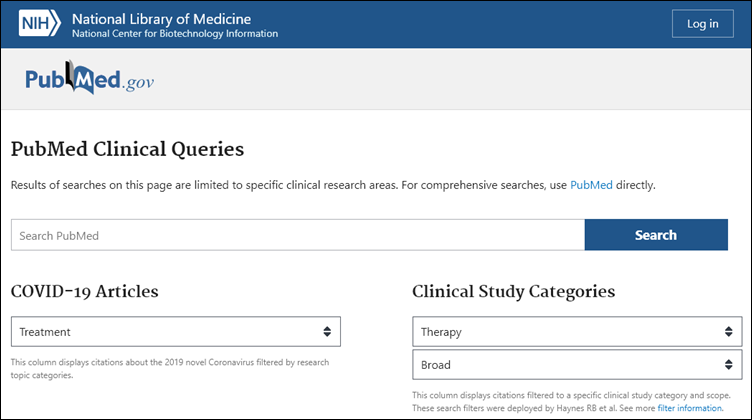
 The PubMed Clinical Queries page will soon be updated with design and content changes. The new page design aligns with the new PubMed and includes a new category for COVID-19 searches. Links and bookmarks created for the legacy PubMed Clinical Queries page will be redirected to the new page when this change takes effect.

The PubMed Clinical Queries page will initially include COVID-19 Articles and Clinical Study Categories (see Figure 1). The new COVID-19 filter strategies are published in the PubMed User Guide and may evolve over time.


Figure 1: PubMed Clinical Queries Page.


The Systematic Review and Medical Genetics filters that were included in the legacy PubMed Clinical Queries page have moved:

  • Systematic Review is available as a default Article Type filter on the filter sidebar for PubMed search result pages (see Figure 2).
  • The Medical Genetics searches are available as filters that may be added to a query using the filter name with the search field tag [filter]: for example, sickle cell anemia AND genetic counseling[filter]. The complete list of filters and associated search strategies are published in the PubMed User Guide.


Figure 2: PubMed Article Type Filter.

For more information about using Clinical Queries and the filter strategies, please see the PubMed User Guide:

By Jessica Chan
National Center for Biotechnology Information

Originally posted to the NLM Technical Bulletin on October 14, 2020.

Chan J. PubMed Clinical Queries Update Coming Soon. NLM Tech Bull. 2020 Sep-Oct;(436):e8.

Thursday, October 15, 2020

Masks May Do More than We Think: ZDoggMD talks with Dr Monica Gandhi


This is recent episode from ZDoggMD' podcast.    

I'd read cited the NEJM article last month and was intrigued with the idea of variolation, so I was happy to hear one of the authors talk about it in this discussion with Dr. Zubin Damania (aka ZDoggMD).   Dr. Gandhi also goes over the current state of the evidence re: face masks.  I was pleased to hear that I was familiar with all the studies she talks about concerning the efficacy of masks to prevent transmission of respiratory infections.  Dr. Gandhi comes from a background of treating patients with HIV, and has a different approach to convincing people to take care of themselves and others, whether it be wearing condoms or face masks.  No shaming here. ;-)

I hope you enjoy it as much as I did!  

Here is the PubMed citation for her article: 

Facial Masking for Covid-19 - Potential for "Variolation" as We Await a Vaccine.
Gandhi M, Rutherford GW.N Engl J Med. 2020 Sep 8. doi: 10.1056/NEJMp2026913. Online ahead of print.  PMID: 32897661

Masks May Do More Than We Think (w/Dr. Monica Gandhi)


From ZDogg's introduction to this episode:

What if masks acted to reduce severity of COVID-19 infection for the WEARER, fostering immunity like a vaccine and allowing a full societal reopening?

Dr. Monica Gandhi is a UCSF professor of Medicine in the division of HIV, infectious diseases, and global medicine. She and her colleagues recently proposed just such a theory in the New England Journal of Medicine. In this fantastic interview she outlines the emerging data in support of the idea that masks may do more than we think.

Here’s a NY Times piece about her proposal, and here’s a paper she co-authored in the Journal of General Internal Medicine.

And here’s ZDogg's piece on masks that summarizes some of Dr. Gandhi’s work.

Full Transcript is available at ZDoggMD.

References (directly from Dr. Gandhi) :

Viral inoculum theory: Higher viral inocula or “dose” linked to severity of disease

Well described in animal studies and some human studies for respiratory and GI illnesses -higher infective dose thought to lead to faster/greater pathogen replication, leading to a more aggressive and damaging innate inflammatory response, or overwhelming adaptive immune response- all leading to more severe disease.   This is a hypothesis for diseases in which immunopathology plays a role in viral pathogenesis, such as COVID-19 (Rouse BT, Sehrawat S. Immunity and immunopathology to viruses: what decides the outcome? Nat Rev Immunol. 2010;10(7):514-526)

Some evidence for the “viral inocula” theory for SARS/MERS. Evidence in SARS-CoV-2 fom degree of illness in household contacts/ health care workers at beginning of pandemic.  Papers supporting viral inoculum theory. [43 more citations available at ZDogg's site.]

Friday, August 14, 2020

Risky Business: Know Your Risk During Covid-19


The Texas Medical Association published this graphic explaining the relative risk of different activities during the current Covid-19 pandemic.   

This was brought up at a recent Covid high reliability meeting at my organization, reminding us to keep vigilant and not succumb to pandemic fatigue, with reminders to 

  1. keep up social distancing
  2. wear a mask properly
  3. and wash your hands.

Interesting that visiting a Library or a museum is rated at Level 4 and working  a week in an office building is rated a 6 -- which is why many of our Libraries are still closed. 

Sigh!  When can we go back to life as normal?

Monday, June 29, 2020

Debunking Bad Covid-19 Research


MIT Press and the University of California, Berkeley, are leading an effort to rapidly review research related to the pandemic and stop the spread of misinformation.

This article from Inside Higher Education describes the creation of an "overlay" journal on COVID-19 research from MIT Press and the Berkeley School of Public Health.  
  • An overlay journal  reviews already-published preprint articles.


Submitted for the WHSLA Blog by Barbara E. Ruggeri, MLIS, AHIP,
Life & Health Sciences Librarian at Carroll University

Tuesday, June 16, 2020

COVID-19 article retractions

Article retractions are not unheard of in medical literature. However, the speed at which COVID-19 research has been published in the last few months has caused some concern about recent, high-profile retractions in NEJM and The Lancet, related to coronavirus.